

Going to Pisco
6 September, 2007, 05:18 am in "Peru"
 The busride to Pisco was fairly uneventful. The only thing worth mentioning is how the damage from the earthquake got more and more apparent as we got closer. There was a brief stop before Pisco which involved a detour through a small town because the Pan-American Highway was damaged. The town looked decimated and as the bus went by bunches of children ran along next to it with outstretched hands, and the ruins of buildings behind them.
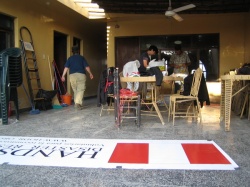
 We arrived at the HODR headquarters building: a restaurant that the organization has rented for housing volunteers. We rang the doorbell but no one answered. Our phone calls weren't answered either (later I found out that I needed to add a zero). We walked down the street to a restaurant and got some chicken and rice. The woman in the house next door insisted Stephanie, one of the managers of the program, was in the house, so we rang and knocked. Finally she came to the door. She had been busy cleaning and hadn't heard us.
The first task was to clean up the hq so it would be livable. We scrubbed floors and walls. There had been a mini-tsunami which had coated the floors and about a foot up the walls with dirt and salt. A little later, two more volunteers arrived (we were the first to arrive), Charlotte and B. We ate dinner together, talked a bit then settled down for the night.
The next day was devoted to more cleaning and preparing the tools for the volunteers to start work the next day. We also took a trip to the market. The town has rubble everywhere but life goes on and people are busy working. I guess the government is paying people 14 sols a day to work so I think there are a lot of enthusiastic workers around, cheerfully running around with shovels. It's overwhelming seeing all the ruins and all the work that needs to be done--and frustrating to be lazing around here because more preparations need to be made before we start. Hopefully we'll start working tomorrow.
Last night after dinner we came home and saw a huge dog in the courtyard. He barked a bit but eventually we gained his trust when Charlotte started feeding him cookies. Since we didn't know his name, Rowshan called him Doggie, which the next morning we learned was actually his name.
In the morning, we found a second dog in the courtyard who had come over from the neighboring building where the navy has taken up residence. He was a big grey dog and liked jumping on people. The dogs seemed to get along OK until suddenly a fight broke out when Doggie's owner appeared ("Quick! Look like I'm guarding the house!). The navy guys had to pull their dog while Lalo pulled his dog away.
Pachacamac: Culture is Liberty
7 September, 2007, 04:42 am in "Peru"
 The minibuses to Pachacamac do not stop on the corner of Ayacucho and Grau as stated in the Lonely Planet. To get to the stop you have to walk a block up the street then down to the stations that are in a lowered street. Easier still, we could have caught the bus from Plaza Grau which is about 2 blocks from our hostel.
 The bus was very crowded and about half the way to our destination I received the answer to a question that has been running through my head lately: What happens when the minibuses break down? Ours broke down with a clamourous rattle of metal and a billow of smoke. Everyone got off the bus. As more minibuses pulled up behind ours, the our conductor paid the conductor of the new bus for each passenger that boarded. The bus route went through what probably wasn't the most fashionable part of town--industrial areas mixed with crowded living spaces. A couple areas were hills that were completely covered with concrete and brick houses, one seeming to grow out of the other. It was as if the entire hill was made out of ramshackle buildings. No street was visible (though there must have been something). On one I noticed a steep yellow stairway which stretched up the "mountain."
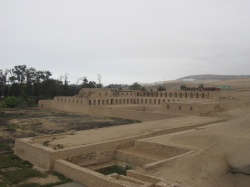
Pachacamac is in an area which on one side overlooks the ocean. One side overlooks fertile fields and one side looks toward the desert. The ruins are from several different time periods. Usually I shy away from guides when visiting places, wanting freedom to linger over one thing or anotehr or just willing to read signs and descriptions myself. However, realizing how many ruins there were and how many were just piles of bricks, we decided a guide would help enlighten us.
Our guide, Marcelo, rocked! He was enthusiastic, knowledgable, had a great sense of humor and fine storytelling skills. He was possibley the most interesting tour guide I´ve been on a tour with. He moved quickly, which I appreciated, and insterted the history into the conversation in enticing tidbits, instead of long boring descriptions. Sometimes he'd speak secretively then suddenly burst out into a dramatic explanation. He explained about the Wari, the Lima, the Icha and the Inca (making sure we remembered the names). He showed us the clay vessels made for drinking or snorting mescaline and recommended "no more than 2 cups" ferment corn alcohol.
The Lima ruins, he explained, were recognizable by the bricks being set vertically which made them stand up better during earthquakes (They could move with the wave as opposed to crumbling.) He talked about the class issues through time and how the nobles walked on the raised edges of the road above the heads of the commoners.
One thing he mentioned several times was how upset he was that more money wasn't being spent on the excavation and restoration of the ruins. He said that excavation would answer more questions and make the people more knowledgable about their history. "Culture is liberty." That is probably my favorite line that he said. Culture shows the best of every society. It is what is produced to express what is loved most by the people and what is most important. By letting a people know their cultural history, they can know what is best about who they are and who they were. It is important to have that pride.
Some Cool Things We´ve Found in Lima
3 September, 2007, 09:38 pm in "Peru"
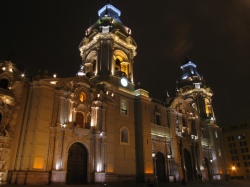
- Cafe Italiano: on Avenida Jose Larco at Gonzales in Miraflores.
We have been here every day so Rowshan can get his coffee and I can get their wonderful hot chocolate. - K'antu: Av Grau in Barranco. Free trade gifts, coffee and tourism. This is another nice cafe.
- Evening walk up Jiron de Union to Plaza de Armas over to the river: This seems to be really popular among Limenos. It is a nice way to end the day. By the river there is a market with lots of folkloric stuff and a stage with musicians
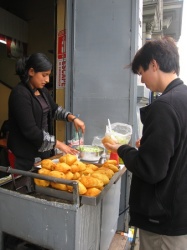
- Papas Rellenas: We love the papa rellena seller in front of a restaurant across from the Parque de la Cultura on Arequipa (about a block down from the top of the park). 30 cents will buy 2 hot yummy fried mashed potatoes
 .
. - The Bird Walk: This isn't really what it is called but it is a serene path in San Ysidro which is about a block away from busy Camino Real on Choquehuaca. Along the path are signs about all the different birds in the area.
- The Music Stores and Workshops in the Plaza 2 de Mayo.
[ View 2 Comments
|
]
Powered by My Blog 1.69. Copyright 2003-2006 FuzzyMonkey.net.
Created by the scripting wizards at FuzzyMonkey.net..
(Code modified by Rowshan Dowlatabadi)
Created by the scripting wizards at FuzzyMonkey.net..
(Code modified by Rowshan Dowlatabadi)