

Valparaiso: Head in the clouds and feet on the ground
28 January, 2008, 11:26 am in "Chile"
 We have our techniques for arriving in a city and getting settled without reservations: Usually we go towards an area with a few hotels listed in LP, or head to the center of town. We find a cafe (have breakfast if arriving early from a night bus) and Rowshan guards the bags while I scout for hotels. This generally works, however, Valparaiso is not set up like the "usual" town. First of all, there isn't really a definite center. Second, most of the budget lodgings are in family run b&b's and no one is up until about 9. Third, the lodging is in residential areas so nothing is open until 9. This is great for people who like to sleep in but bad when you arrive at 6 AM, dazed and bleary from an overnight bus.
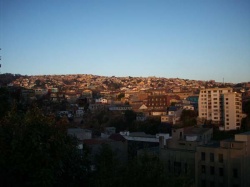
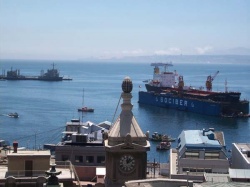
We headed to the hills Concepcion and Alegre, where there seemed to be a concentration of lodging, and found padlocked gates. When a tired voice did answer my phone call, we were told to call back after 9. These are the most difficult times while traveling: you want just 3 things: to eat breakfast, use a toilet, and take a nap. Instead you are forced to find a park bench and wait in the semi-darkness. We found a plaza with benches, one containing a sleeping occupant. The plaza happened to perched on an overlook. We looked over the city at the harbor, listening to the seagulls' morning cries. The seagulls and the view reminded us a bit of Istanbul.
Then the sun slowly began to rise. The scene became gently washed with colors and it was impossible not to be struck by what a beautiful place we were at, high on a hill above the city, with the palace of Belles Artes behind us.
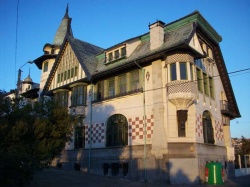
Around 7:30 I decided to do another round of the neighborhood looking for signs of life. Eventually I found a b&b owner who was up and about. By 8:30 I had even found an open cafe. Life is good.
Rowshan and I had breakfast, checked into the B&B and another tough arrival was vanquished. Later, we descended into the lower part of town. This is the other confusing thing about Valparaiso. The town has two parts: the lower part alongside the water and the residential part in the hills above. The hills where we are staying are UNESCO historical sites so I imagine they might be more beautiful than the others which I haven't seen yet. The hill we are on is ethereal--perched above the city; there are cafes, galleries; historic houses with high ceilings, and the smell of fresh baked bread drifting from bakeries.
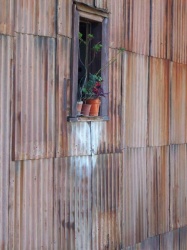
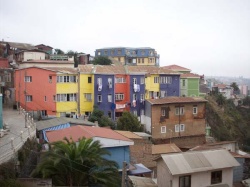
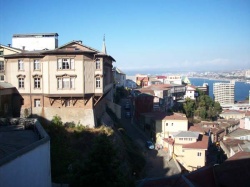
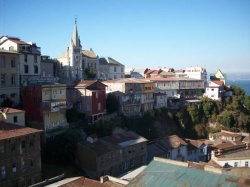
It is a place for enjoying life but in a refined way. Descending to the lower part of the city is a little like leaving the clouds and landing in the dirt. It is a place grayed by car exhaust where even the historic buildings, painted in pastel colors have been dulled. In many places at street level the neo-classical columns and pastel paint have been replaced by large modern glass panes and metal as well as big plastic signs whose bright colors have been shaded by exhaust. The quiet simplicity and the silence of the hills, broken only by seagulls cries is torn asunder by the roars of buses and taxis, the blare of shelves of TVs, rows and rows of cheaply made products, posters screaming out deals and the cacophony of the modern world.
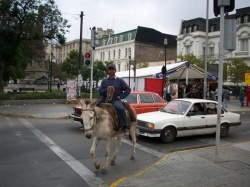
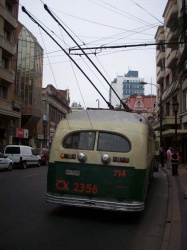
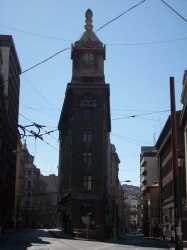
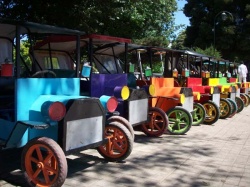
The lower part of town is where the mundane takes over: markets, fast food; stores... In front of the buildings is the port where there is once again a flash of color as the buildings give way to shipping containers, toy cars in a park, and restored buildings on the waterfront.
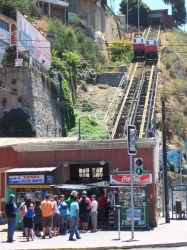
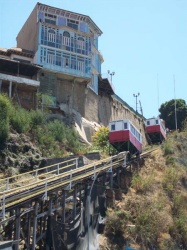
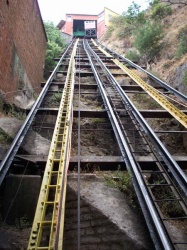
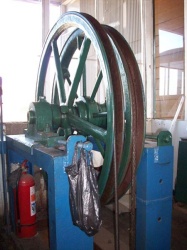
These two worlds are connected in many places by historic "elevators", small funiculars capable of holding about 7 people in each car.
After a lunch of pizza, chicken, french fries, and ice cream, as well as a trip to the station to buy bus tickets, I was already missing the serene elegance of the hills.
Ovalle: Martians and Underpants Gnomes
27 January, 2008, 11:04 am in "Chile"
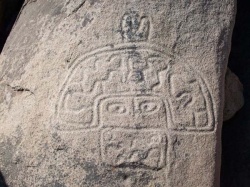 Short on time, and wanting to get a glimpse of Northern Chile, we took a bus this morning to Ovalle, a small city surrounded by farms and vineyards which disappear into hot, dry desert hills. The main reason we chose Ovalle was there was a ceramics museum for Rowshan, a cloud forest a couple hours away for me and some petroglyphs. Due to the shortage of time and lack of public transportation to the cloud forest, we eliminated that early on.
As we arrived into town, we both were equally unimpressed so decided to just visit the museum and petroglyphs and then take a midnight bus to Valparaiso. We managed to find the museum only to learn it was only open Tuesday through Friday meaning it was closed and would be for the next 2 days. We went back to the bus station to catch a Santiago bound bus back 19 km to the road to the petroglyphs. Unfortunately, the next bus was at 6PM so we had to take a taxi. This proved to be a good thing since the road to the petroglyphs had no shade and the weather was sizzling. As we were driving out of town we passed multicolored gypsy tents.
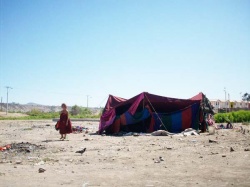
We'd passed some others earlier during the bus ride but I wasn't sure they were Roma because they looked like small circus tents with their festive bright colors. As we drove to the site, we discussed life in Chile and politics of the US with the taxi driver.
At the site we were handed over to the ticket and general info guy who immediately asked us "Bush or Clinton?" To which we replied Clinton. Then he asked, "Reagan or Carter?" He gave us a quick intro: "Here is the trail, the petroglyphs are marked with white arrows. Down there is the Martian." He gestured with his fingers like antennae over his head. I felt bad turning down the offer of a tour guide since the guide looked kind of dejected when we did. He resembled Roberto Benigni.
We walked down into the Valle del Encanto and followed the signs to the petroglyphs. There were often faint and hard to make out. But then they were supposed to have been created by a culture from 2000 years ago. There were a few clearer ones including the "martian." The info office had a cartoon version titled, "Man with television head."
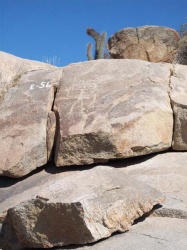
The area was hot and dry with cactus and large boulders.
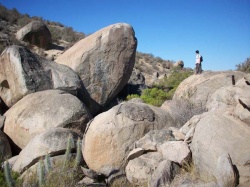
There were several areas with grinding stone holes as well as some pictographs which were fainter than the petroglyphs.
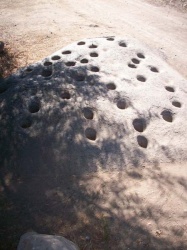
There were also a couple shelters. The petroglyphs were spread out and we had to follow footpaths made by other tourists, some leading nowhere, others leading to a petroglyph. There were murky algae filled pools between some of the rocks as well as an area signed, "Incan Baths." Our deal with the taxi driver was he'd wait an hour for us (not that he'd leave since we hadn't paid him). We rushed about trying to make sure we didn't miss anything. There were strange stick figures, square heads with antennae and heads with what looked like sun rays. There were also a couple stick figures holding what looked like a pair of underwear between them... Could they have been ancient underwear gnomes?
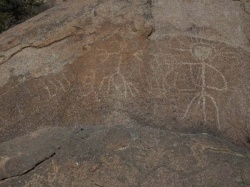
Apparently it is easier to see the petroglyphs when the sun is directly overhead. I wonder what inspired them: futuristic premonitions of 1950s alien invasion movies?
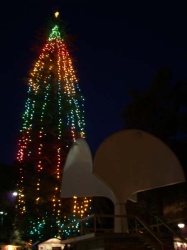
Back in town we hung out in a cafe. As it got dark, the Plaza de Armas was lit up with Christmas lights on a giant evergreen tree in the center. Surrounding the evergreen were huge palm trees also decorated with Christmas lights.
We Love Santiago!
25 January, 2008, 11:04 am in "Chile"
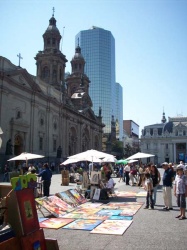 Santiago: the word has an elegance to it: a smooth drawl, classier than the curt sounding San Diego. The name seemed to promise something unmentioned by the guide book.
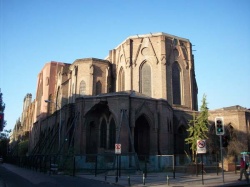
Santiago is an unsung cultural capitol. Why hadn't I heard anything? With at least 4 art museums (1 brand new), numerous cultural spaces and galleries, why hasn't the art world been singing its praises? It isn't just the city's dedication to the arts as expressed by the new spaces, art seems to have permeated the city and oozes from it. A walk down an unfamiliar street reveals some new artistic surprise: a wall of a building painted with a mural, hip stencil graffiti, the tragic beauty of a cathedral ruined by the 1985 earthquake with statues and decorations broken and threatening to crash to the ground with the slightest tremor.
We like Santiago! After a restful 14.5 hour bus ride, highlight being a beautiful view of the moon rising over a snow capped volcano, we arrived in Santiago, checked into a hostel and began wandering.
We were met by green parks and plazas, pretty historic buildings, lots of cobblestone pedestrian only streets, and lots of cafes.
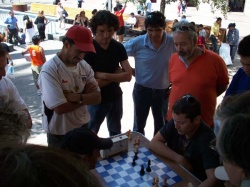
The Plaza de Armas was full of painters and there was a covered area full of chess players.
We passed restaurants, including lots of sushi places, a few middle eastern places, as well as enough cheap lunch set menu places to keep us happy.
The hostel was down the street from a beautiful cathedral in a rather disastrous state due to an earthquake in 1985.
We walked around then took the metro to the Bellas Artes neighborhood. This area was full of boutiques, trendy restaurants and bars, as well as "Artesania" shops (mass produced "art" for tourists). However the buildings were charming and some had been nicely restored and painted with bright colors. One building was particularly interesting looking though a bit out of place with the rest of the architecture in the area.
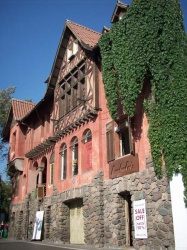
As we were wandering aimlessly, we noticed a building with a sign advertising art workshops and a gallery. Taller Tierra Luz
We walked in and found ourselves in a room with earth colored sculptures of figures along with ceramic relief pieces and abstract paintings. A young woman, Maria, wearing a work apron turned on the lights in the gallery for us then went back to the room behind the gallery where she and another woman were working at a table with clay mixed with a gritty substance.
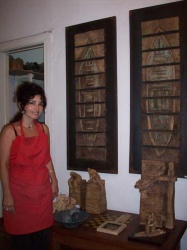
It turned out most of the pieces in the gallery had been created by Maria. She showed us her work and around the workshop. Rowshan discussed ceramics with her. She has a really interesting sculpture series of vertical shapes with stairs and figures on them.
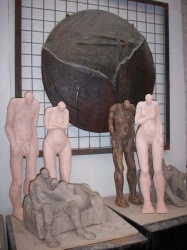
Eunice, the other woman who was working, had some pieces on display which used figures taken from petroglyphs which was more in line with what Rowshan does.
The women seemed glad to take a break from their work to discuss clay components and firing temperatures with Rowshan while I wandered around the gallery admiring the pieces.
Walking back to the hostel we succumbed to the temptation of a cardboard cutout of a smiling Japanese sushi chef holding a plate of sushi... as well as a "50% off dinner promotion" sign. The restaurant was a sparse, light space with light wood tables: essentially it looked like a nice sushi restaurant. It smelled good too and, judging from the availability of fresh salmon, it was a good choice. Soon we were scarfing down rolls, praising the many qualities of Santiago.
After a sleepless night at La Casa Roja due to a couple loudmouth drunks who ignored numerous requests to shut up and kept everyone awake from 4AM to 7AM when they were replaced by a group returning from bars from 7AM-8AM, we had to admit that maybe we are grown-ups now and have to stay at grown-up hotels where you can sleep as opposed to backpacker hostels with all night bars inside.
Since we couldn't sleep we got an early start, found a cafe and I succumbed to the tempting Chilean concept that cake and coffee is a legitimate breakfast, and chose a slice of chocolate caramel cake. Then we headed to the Pre-Colombian museum which contains a huge collection of ceramics from Pre-Colombian cultures stretching from the Southwest US through Central America and down to South America. It provided a great overview of South American ceramics and served as a bit of a refresher course, tying together all the different art styles we've seen at various sights and places we've visited.
After moving into a grown-up hotel, we went to one of the two museums at the Palace of Bellas Artes. It had exhibits on architecture as well as a lot of installation pieces. Then we found ourselves in a room of Colonial religious pictures. I glanced quickly at them since I've seen way too many and am a bit sick of them... Then I realized that one, which had a typical praying figure also had a guy with a microphone and a sheep sticking out its tongue. Indeed, it was the only contemporary piece camouflaged in a room of Colonial religious art.
The Museum of Contemporary Art is a white spacious space. The downstairs featured large video installations. The middle was the chaotic site of a children's' art workshop as well as a gallery of wall art pieces including digital art and a brilliant picture of a tree made entirely from burnt toast! The upstairs had sculptures and an unexpected shift from modern to ancient as we walked into the attached Archeology Museum. The Archeology Museum at first appeared to be another installation--a dark room with a video screen at the back and cases whose contents weren't visible from outside the room. Once inside, they revealed ceramics from various cultures (Diaguita, San Pedro Negro Pulido, San Miguel/Pocoma-Gentilar, Molle, Acongagua) and other artifacts.
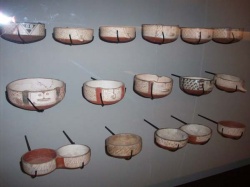
After our morning art fix, we had falafal sandwiches with fresh peach juice before walking up Cerro Santa Lucia. There are a few large hills in Santiago which rise from an otherwise flat city. Santa Lucia is a tree, garden, and tower covered hill in the center of town.
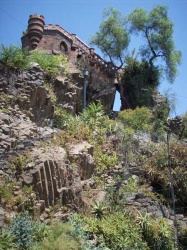
Stairways lead around fountains and by towers, galleries, and a chapel.
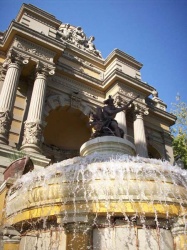
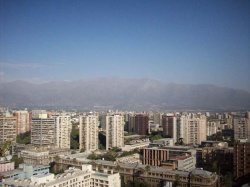
At the top is a tower that looks down over the city. All around the city we could see the hazy shadows of mountains. Rowshan pointed out that they resembled the Alborz mountains north of Tehran.
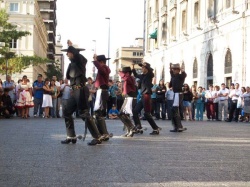
Later as we passed through the Plaza de Armas, we managed to catch the last couple dances of a folkloric troupe performing traditional Chilean dances. For one, the mean, wearing paniola outfits and cowboy boots with big silver spurs, did a dance using the rhythm of their boots on the pavement and the jingling of their spurs.
Our last day in Santiago brought more pleasant surprises. As we were walking toward the new La Moneda Cultural Center, we passed a building covered with interesting paintings. A few blocks down, Rowshan heard music. We walked up the block and saw a group of 50 musicians playing lots of guitars as well as other instruments: pan pipes, flute, cajon, saxophone, and singing. One held a human sized puppet. In front they held a brightly colored banner with a cheerful design of a guitar player singing.
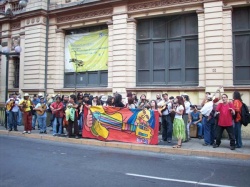
I watched, enjoying the music and wondering what it was about. The sight was almost surreal: a group of musicians singing and playing holding a banner of a musician singing and playing. It looked like a protest but what was their message? Take a break from your daily rush and listen to the music? We asked some of the musicians what was going on and it turned out to be a protest against the Department of Transportation which was either not allowing the musicians to play in the street or requiring them to pay for licenses. It looked like many of the performers already had licenses so perhaps they had paid and weren't being allowed to play. It was a bit difficult to understand the man's Spanish with all the street noise as well as the music of 50 musicians. There also seemed to be the desire to show the Dept. that they weren't blocking pedestrians. The musicians kept a path open on the sidewalk for pedestrians to pass through. I walked through twice because it was fun to walk through a tunnel of smiling, friendly musicians, serenading you as you go by. People looked perplexed but many stopped and listened a bit, smiling. Viva La Musica!
Santiago Street Musicians
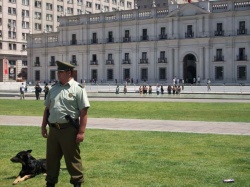
We reached the museum and found another protest. It was Friday. Rowshan has this theory that people in South America protest a lot on Fridays because they want a long weekend. This protest involved a lot of people standing in the pools in front of the presidential palace. One woman was holding a banner that she would occasionally flash open then crumple again so it was unreadable. I didn't succeed in reading it in the 2 second intervals that she had it open.
The museum was an elegant underground space with 2 exhibits: one on Chilean artist/musician Violeta Parra, the other on Spain. I was impressed with the exhibit design: introductory walls had tiny video monitors embedded as well as explanations, quotes and photographs. The Spain exhibit was in an elegantly dark room with maroon pedestals surrounded in glass for the pieces which were beautifully lit. There was also a folk art shop/exhibit area with an exhibit on ceramic sculptures of Chilean life from the village of Talagate.
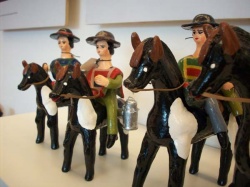
Later we decided to take a walk North of the center. Here we stumbled upon an old train station that had been transformed into another cultural center. In the glass walled area where the trains used to arrive, people were setting up for an opera in the evening, putting final touches on scenery and setting up chairs. Upstairs was a photography exhibit of images of women from Guatemala.
We continued across the river where we admired a little cathedral.
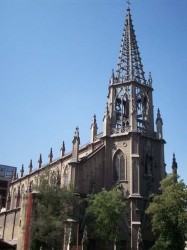
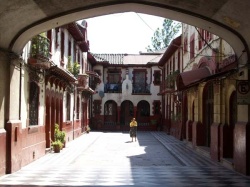
This are had lots of fabric and clothing stores. The area felt very lived in but it still had pretty buildings, contributing to our theory that everywhere you look in Santiago, you can find something interesting.
Powered by My Blog 1.69. Copyright 2003-2006 FuzzyMonkey.net.
Created by the scripting wizards at FuzzyMonkey.net..
(Code modified by Rowshan Dowlatabadi)
Created by the scripting wizards at FuzzyMonkey.net..
(Code modified by Rowshan Dowlatabadi)