

The Salar (Salt Flats)
19 December, 2007, 09:01 am in "Bolivia"
 DAY 1
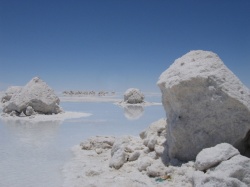
DAY 1Our tour of the Salar de Uyuni, the largest salt flats in the world, and vicinity started this morning. By 10 the sun was shining and the day looked beautiful-- a relief after the downpour the night before. We had scheduled our trip with Jenette, a woman from Norway studying in Buenos Aires, with whom we also went on the mine tour with. We ran into her again on the bus to Uyuni. Also at the office was Pippa, from Australia who had been volunteering in Urubamba for 3 months. We were missing 2 more people who were supposed to have arrived from La Paz in the morning.
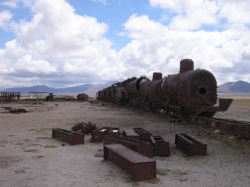
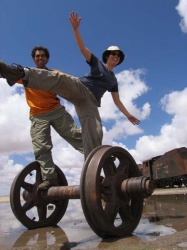
We left anyway and went to visit the train cemetery which was one of the sights in town: a patch of land covered with rusting locomotives and piles of scrap metal.
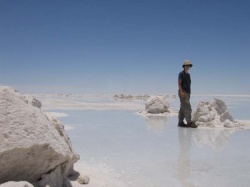
We swung back by the office but the 2 other members of our group still hadn't appeared so we went to Colchani: a tourist trap of a town with a few salt block buildings, stores selling souvenirs and "museums" of large kitchy salt sculptures. While we were wandering around, another jeep from our tour agency pulled up bringing Fred and Marisa, whose bus had gotten stuck in a river for 4 hours on their way from La Paz.
We started seeing the stretches of white and eerie combinations of mirage and reflections from quite a ways off.
I had been worried that since we were getting into the rainy season we'd miss seeing the magnificent expanses of crystallized salt. As it was, I think we got here at the perfect time. The tour company told us the downpour of the previous night had been the first heavy rain of the season. The Salar would be crossable for about a week, then there would be too much water to reach the Isla de Pescado. We had enough water on the flats to create beautiful hallucinogenic reflections of mountains, "islands", people and cars. Yet, there were also the great expanses of white salt, dried and crystallized into honeycomb patterns.
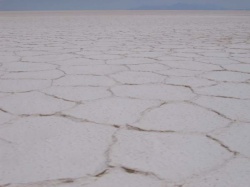
The Salar is a huge flat area that shifts between unmeasurable spaces of sparkling white and other shimmering sections where the water creates a perfect mirror of sky and islands. It's hard to judge spaces. It's hard to tell where the sky ends and the earth begins. Looking off in the distance it seems you are approaching a lake with a building or car floating on it. Then the lake shimmers into non-existence as you near it, fading into a mirage. Other times there really is water which looks like it is a sea but in reality is only a centimeter deep. Islands and mountains rest on perfect reflections of themselves and seem to float in the sky.
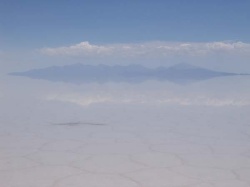
People seem to be walking on water. On a grand scale the snow-looking salt, dissolving into reflections on the edges seems magical, beautiful and peaceful. It is also a little frightening since it feels like being in a huge desert where you can't be sure what is real and what is a mirage.
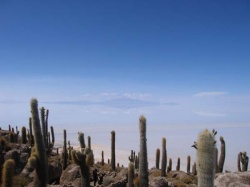
In the middle of the Salar is the Isla de Pescado. Iit seemed to float in the sky.
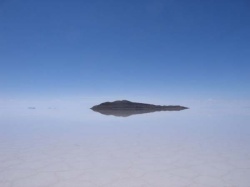
As we got closer we could see tall cacti, looking unworldly in the middle of what resembled a frozen lake. The island has paths and is made up of rocks that resemble a coral reef. In reality they are volcanic rock but viewing the "coral arch"
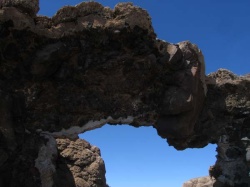
it was easy to imagine fish swimming around the rocks. The island offered a stunning 360 degree view of the Salar as well as a volcano with a huge crater blown out of the top.
We ate lunch at tables made of salt
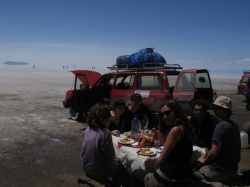
and then continued across the salt flats to get to the village where we'd spend the night. That night we had a delicious dinner and some unique musical entertainment provided by local children. Rowshan couldn't resist joining in.
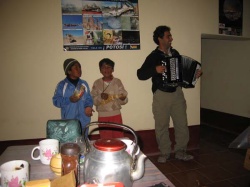
The hostel was in front of a field full of llamas (and/or alpacas)
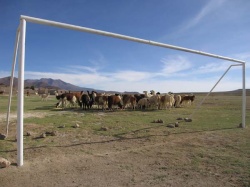
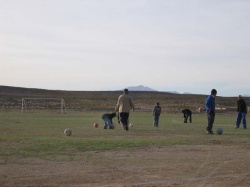
However, in the morning the llamas had to give the field back to the children so they could play soccer.
DAY 2
As we reached our first stop this morning, the Salar de Chiquana, a white field of salt surrounded by red volcanoes, I thought how this area might be the most desolate place I've ever seen.
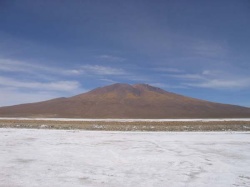
The salt coats the ground so no plants can grow. It looks like snow. The treeless volcanoes, some with huge craters blown from the tops, rise from an otherwise flat landscape. The mountains are above the treeline so are barren. There was a cold wind and with the snow looking salt, it felt like it was in the Arctic somewhere. Even the earth crunched as if it was frozen (though actually it was just extremely dry).
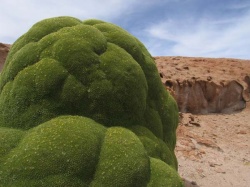
We continued on to a mirador where we could see several volcanoes including Volcan Ollague which had a small plume of steam rising from it although it has been dormant for 100 years. The mirador was an outcropping of volcanic rock. There were a few scraggy bushes and large round mossy plants which resembled green coral.
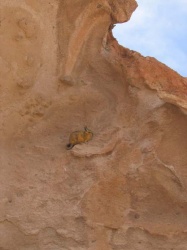
Perched on one of the rocks was a viscacha. It ran and jumped from rock face to rock face looking like a gravity defying kangaroo.
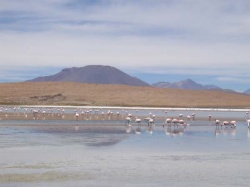
For lunch we stopped at a lake which was full of flamingos. The lake was murky with mineral deposits but the flamingos seemed happy. It was wonderful to see flamingos with their natural pink color and non-clipped wings.
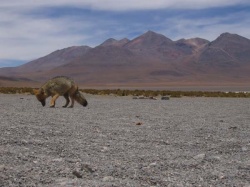
Up the hill we found a couple foxes, one apparently quite used to tourists. It leisurely sat in the parking lot waiting for the leftovers from tour group lunches.
For such a desolate, harsh environment, it is amazing that we've seen so much life.
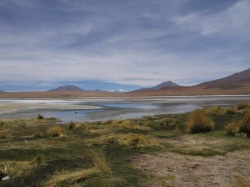
I guess since it is so harsh, humans have stepped aside--no villages, or industry-- and the animals thrive: viscachas, vicunas (animals from the end of the alphabet living at the end of the world), ostriches, flamingos and other birds, foxes and mice.
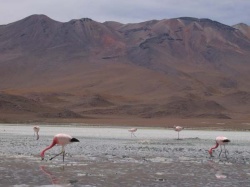
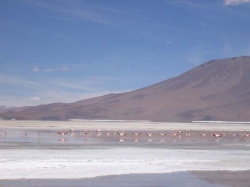
After lunch we drove on through long stretches of flat lands, surrounded by volcanoes
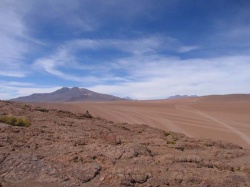
, and occasionally broken by outcroppings of rocks. It struck me that the landscape looked like artist's renditions of Mars, which I'd seen--flat with red, grey, white and yellow volcanoes. We passed by other lakes with masses of sulfur deposits and water colored by minerals.
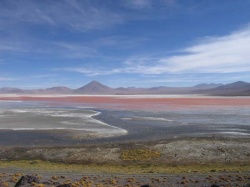
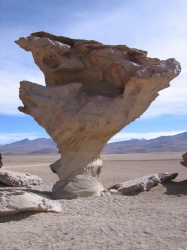
The flamingos stood in the small patches of water not filled with deposits, sometimes walking across white sulfur/salt deposits with their long legs. Another stop was an outcropping of rock called the Arbol de Piedra (Tree of Stone).
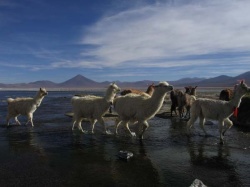
At Laguna Colorado, large patches of the water was rust colored. The afternoon brought strong winds, yet multitudes of flamingos stood on one leg, completely oblivious to the gusts. A herd of alpacas grazed by the lake.
DAY 3
Valero, our guide, woke us all up around 4:30 AM. We had been forewarned (and I secretly hoped it was just a prank). We were all staying in one room and had finished off a couple bottles of wine the night before while playing a silly card game called Pig. We did go to sleep early (the electricity was only on for a couple hours until 9:30 PM).
We crawled out of our beds and put on several layers of clothing. It was freezing outside but thankfully, the winds of the night before had ceased. We piled into the jeep, racing to get to the geysers to watch the sunrise.
We could smell the sulfur before we could see the area. Soon the billows of steam became visible. We made it in time and got to see (and feel) the sun rise over the hill, shining through the clouds of steam.
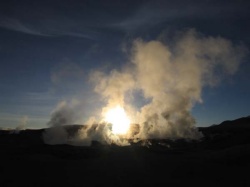
The "Geysers" aren't really geysers but rather fumaroles and boiling mud pits. However, they still are interesting.
There were also some pools of mineral colored water.
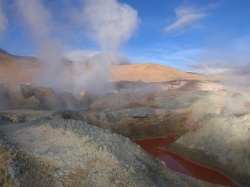
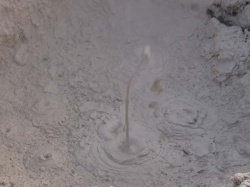
There were sulfur and other deposits on the ground around the fumaroles and inside, you could see the water and mud fiercely boiling.
Our next stop was the hot springs where we would get a warm bath and breakfast. The hot springs were mostly natural--a stone wall had been built to enclose them but the complete structure was built inside the lake.
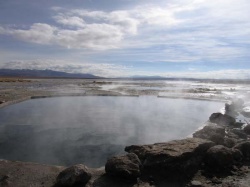
Algae covered rocks and sand made up the bottom. The water felt wonderful and it was hard to face the cold and get out. But we had a tight schedule: 13 hours on the road to get back to Uyuni by evening.
After breakfast, we went to Laguna Verde (green). We'd seen multi-colored lakes in the region--Blanco (white), Colorado (red)-- but I think Laguna Verde was the most beautiful. It was a turquoise green which was set against red mountains.
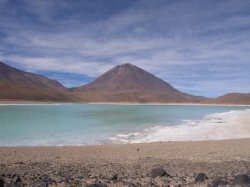
The whole area was filled with intense colors but the lake shone like an inlaid jewel. There were only a few flamingos in this lake and they stood out brilliantly against the green. Valero informed us that this was the most poisonous of all the lakes we'd seen. Its beautiful color was cuased by arsenic which also crystalized into white foam which covered the beaches and floated like miniature icebergs in the lake.
On the way back to the hot springs we passed a strange desert named "The Salvador Dali Desert" due to its resemblance to a Dali painting.
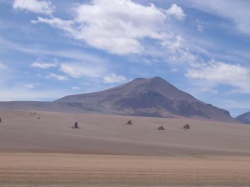
We also passed a pile of stones which someone had dressed up in a jacket. Rowshan joked that it was Dali painting, since it seemed to be looking at the desert.
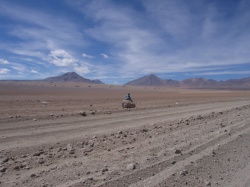
There was a lot of driving and although the scenery was beautiful, it felt long. We descended enough that we got some larger bushes. Our gradual approach to civilization was marked by more llamas and alpacas.
We had lunch in Villa Mar, a village with striking rock cliffs and a tiny bit of river passing through. The center looked like it was built for Munchkins with a tiny church, bandstand, and statue of a condor. A bit beyond was a rock cliff and a rather strange tail of an airplane.
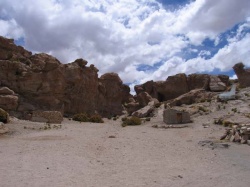
Our main stop of the afternoon was the Valle de Rocas. It was very reminiscent of Arches National Park (though on a much smaller scale) with red rock pillars, windows and huge cracks where slabs of the rock had tumbled to the ground.
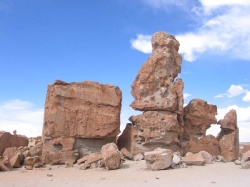
We passed a few villages and more llamas and alpacas. Valero had to honk whenver he came close to a herd crossing the street.
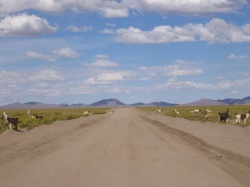
I was delighted when I realized they had yellow llama crossing signs.
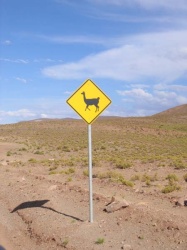
We breezed through San Cristobal to get back to Uyuni by 7. We were tired and dusty (and salty... and sulfury) but it had been an incredible trip and fortunately, Uyuni has some of the best pizza in Bolivia.
Visiting the Mines in Potosi
15 December, 2007, 11:01 am in "Bolivia"
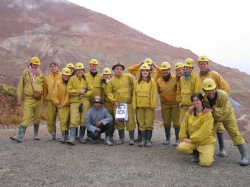 (Note: the historical info in this blog entry is written from memory of what the guide told us on the tour. I haven't had the chance to check all the facts, so please excuse inaccuracies (and kids, don't quote me for any school papers!) )
We went on the Cooperative Mine Tour today. Potosi, charming town that it is, exists for and because of mining. The "Rich Mountain", Sumaj Orcko (Beautiful Mountain), rises behind the city, its triangular shape traced by lights at night.
First everyone was given pants and shirts to cover our clothing, hardhats, and rubber boots. Then we were driven to the "Miners' Market,"
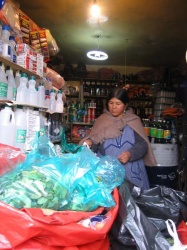
where we could buy gifts for any miners we met (tips for stopping and talking to us): coca leaves, cigarettes, 98% alcohol, drinks, dynamite and fuses.
It was pouring rain as the bus rocked up the muddy road to the mines. I had thought it was cool that the mines were run by a co-op but soon our guide enlightened us about the true situation. 20 years ago the mines had been state run. The miners had safety equipment, electricity in the mines, free schools for their children and other benefits. However, when it was determined the mines weren't making enough money, the state closed them. The miners insisted that they needed work and all they could do was be miners. The state responded that they could run the mines as cooperatives. However, the mines mostly became privately owned with the miners in the co-op paying the owner a monthly fee for the right to mine a claim. Then the miners sell what they find to smelters and refineries which are also owned by the mine owners. The miners must provide all their own equipment. They work in terrible conditions and most die around 50 from siliconitis of the lungs.
The guide showed us how to prepare dynamite and did a demonstration blast.
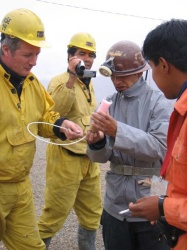
Explosion
Then we headed into the mines. They were cold and damp. Grey mud covered the ground and coated the rock walls. There were only a few miners working due to it being the weekend and the fiesta the night before.
We walked through the passages.
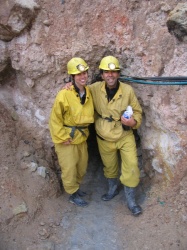
Occasionally our guide pointed out a vein of composite metals. The Spanish had extracted most of the pure silver so now the miners mined zinc, silver, lead, and tin which were found mixed together.
We also learned about the specifics of the work arrangement. To mine a claim, a miner must first start out as an assistant. Usually the assistant helps a relative: father, older brother, cousin. We saw one miner and his 14 year old assistant: his cousin.
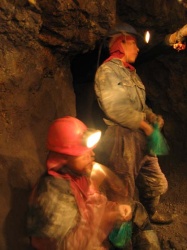
The assistant receives a set amount from the miner and only helps when the miner needs him (about 3 days a week). However, the assistant is not recognized as working (since it is against Bolivian child labor laws).
After working as an assistant, the man can ask the mine owner for a claim. The owner goes over the regulations and tells the miner where he can work, and where he must sell the ore he finds. The miner pays 500 Bolivianos per month to the owner. If he wants to use an electric drill he must pay 150 Bolivianos for 2 hours. Miners can make between 3000 to 5000 Bolivianos a month when the price of metal is good. Other months they make 1000 or less. From this they have to pay the owner and assistant as well as buy all their equipment. Due to this, (and perhaps culture) the miners don't wear masks to protect them from fumes. They also do most of the mining by hand using hammer and spike, and the same techniques used during the colonial times.
We saw a couple miners working. One was drilling a couple levels below.
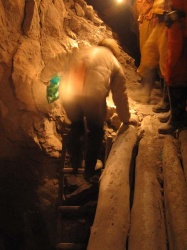
Deeper in the mine it is hotter and has more dangerous fumes but the miners who work there can make more money.
One part of the 2nd level of the mine had a small museum constructed by the miner.
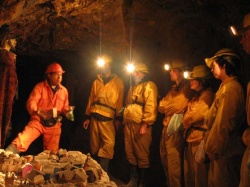
There were some manikins of people who were part of the mine's history: the Inca credited for discovering the mountain, Spanish, African slave workers (who died so quickly that the Spanish started using them to grow coca instead). The indigenous people were used in the mines to do most of the work. Huge numbers died working in conditions so severe and dangerous that the Spanish wouldn't even set foot inside the mines. They also worked in refineries using pools of mercury to process silver causing many to either go mad or die in frighteningly short times (2 weeks).
When the indigenous miners realized the Spanish wouldn't set foot in the mines, they started working less. The Spanish recognized the decrease in silver and invented a "Deus Malo" (bad god) and set a figure of this god in the mine. They told the indigenous people that this god would watch and kill them if they didn't work hard. The miners pronounced "Deus", Tio and the god of the mine was born. In the back of the museum was a large figure, sturdy and fierce. He had an open mouth which was stuffed with coca and at his feet were piles of empty alcohol bottles. The guide placed a lit cigarette in his mouth and showed how the miners anoint the figure with alcohol.
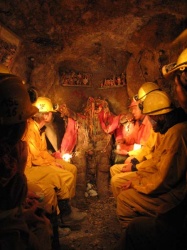
Now Tio has become an indigenous god. The miners offer him gifts so he will provide minerals and protect them. It is believed the union between Tio and the mountain (Pachamama/mother earth) produces minerals. Llama fetuses are buried in the ground so Pachamama will not bury the miners instead.
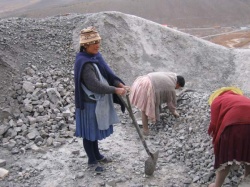
Women don't work in the mines. They say that since the mountain is a woman, having other women in the mine would displease her. The women do work outside of the mine separating the different minerals.
Back on the surface our guide told us how a previous president, (who now lives in Miami) owns a mine. The miners worked in terrible conditions and were going to start a revolution. There was a meeting and the president sent the army which killed all the leaders (25, I think). Later, the wives marched in protest with their babies on their backs an sticks of dynamite. They demanded, "Why did you kill our husbands and the fathers of our children." They said they couldn't survive without them. I don't know if any blew themselves up as they threatened but many were killed. Our guide sang us the song they sang, "Miners Volveramos." The former president's mines are closed now because aside from the human cost, he polluted the river which the communities relied on. The communities have chosen to keep the mines closed to preserve and recover the environment.
The whole mining history seems to be one tragedy after another. The current tragedy is how stuck the miners are in their life styles. It seems there is no way out. All the miners know how to do is mine using ancient methods. There are internationally owned mines with modern safety standards and equipment but they don't hire local miners because they aren't trained in the technology. Instead, the good paying work goes to miners from other countries. The locals are only able to get low paying jobs like watchmen for the mines.
But the miners need work so closing the mines would ruin their livelihood. There is too much distrust of the government for the miners to accept a state run option. So everyone seems stuck. And this is just thinking about the human side and not even considering the environmental costs.
Potosi Festival
14 December, 2007, 11:01 am in "Bolivia"
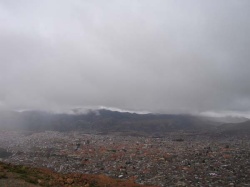 Arriving in Potosi, the first taxi driver we asked refused to take us to the center of town because of a "Carnaval" which meant the traffic was terrible. The next one took us and traffic certainly was bad for such a small town. The narrow streets were packed with vehicles. The main square was blocked off completely.
 It turns out that we had managed to blow into town during a cultural festival. We watched group after group dancing traditional dances, accompanied by flutes, drums, and/or the singing voices of the dancers.
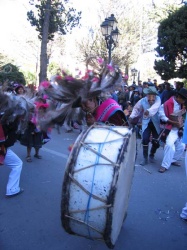
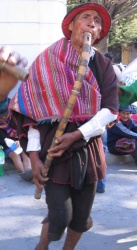
The groups marched in a parade through the street then would stop in the square and perform in front of a canopy.
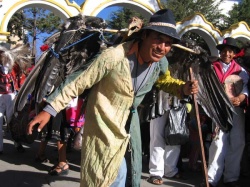
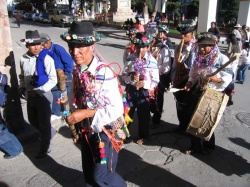
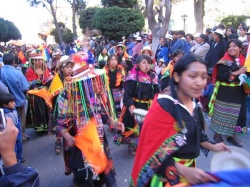
Then the procession would continue until the next group was in front of the canopy.
One interesting group was the miners and their families. We passed them in the street. Some where sitting on the pavement drinking while others stood in formation enjoying themselves as they waited for the procession to move on.
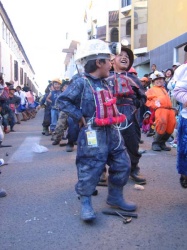
Going around the block, we saw the miner children in miners' coveralls and hardhats. They were dancing/marching to the sounds they made by hitting spikes with hammers.
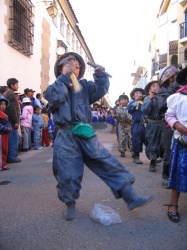
Potosi Miner Kidīs Prade
They were followed by the older kids (apprentices probably), the wives and the miners.
Potosi Festival
Potosi is a mining town. Most of the industry in the town is mining or mine related (processing, transportation, handcrafts from mined metals). The celebration went on for hours, the dancers replaced by music groups into the early morning hours.
Powered by My Blog 1.69. Copyright 2003-2006 FuzzyMonkey.net.
Created by the scripting wizards at FuzzyMonkey.net..
(Code modified by Rowshan Dowlatabadi)
Created by the scripting wizards at FuzzyMonkey.net..
(Code modified by Rowshan Dowlatabadi)