

Sucre: Anarchy and Giant Lizards
13 December, 2007, 08:27 pm in "Bolivia"
 When we told a guy at the Andoriņa Hostel we were going to Sucre, he asked, "Is it safe there now?" When we gave him strange blank looks, he asked, "You do know what's been going on in Sucre, right?" We had to admit we really didn't. "Well... someone should probably tell you." He launched into a very long explanation, "A couple weeks ago, Sucre was in a state of anarchy and the police fled."
"Oh!" I exclaimed, "That must have been the town we saw on the news where people were burning stuff and rioting!"
We couldn't remember how long ago it was or where we'd been when we'd seen it. One thing we did know was when we saw it, we weren't familiar with the name Sucre.
Our friend continued, "A couple weeks ago parliament met in Sucre to create a new constitution. Someone proposed that the capital should be returned to Sucre and the idea took off. Huge numbers of people descended on Sucre trying to have this proposal enacted as part of the constitution. The other hot issue was autonomy. The lowland cities like Santa Cruz, are wealthier so have been outraged by the socialist proposals of Evo Morales, the new president, which would require them to share the wealth with the poorer highland areas. Many of these wealthier regions are calling for autonomy. Sucre wants autonomy too. With all the protests, the constitutional assembly was moved to a military location. Many representatives from different parties boycotted it since there had been so much public outrage. Morales' party met anyway and voted on and rectified the constitution without the other reps. This made everyone furious and that is when the violence on the streets broke out. The police fled and the city was left in a state of anarchy. The police then returned and probably everything is OK now."
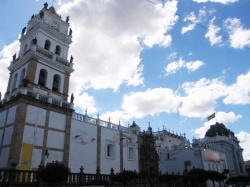
When we got to Sucre, everything seemed laid back. There was a lot of graffiti but large amounts had been covered with fresh paint. People went about their daily business. The sun was shining and the white washed buildings also shone against the blue sky. It didn't look very scary at all. There were political messages hanging from buildings and in the center political music was blasting in the main square.
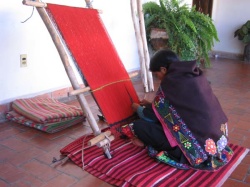
We decided to visit the ASUR Museum of Indigenous Art. This was a fascinating museum of local weaving traditions including pieces that were representative of a revival of the weaving art, supported by ASUR. It also had sections on traditions, dance constumes and music.
The next day we went to the main square at 9:30 to wait for the Dino Truck. It was an hour or 2 late. Probably the most famous site in Sucre is found next to a cement quarry. A huge wall, or rather a cliff face juts slanted into the sky. It is covered with dinosaur tracks. According to a tourist info map, it is the largest paleontological site in the world with over 5000 dinosaur tracks from 332 types of dinosaurs. To get there you board a truck with dinosaurs painted on the side and dino claws on the carriage roof.
The site itself can be seen from the road, but for a slightly better view and an opportunity to see a small museum and numerous dinosaur sculptures, you can pay around $4.00. Unfortunately you can't walk next to the wall, only view it from a viewing area at a bit of a distance.
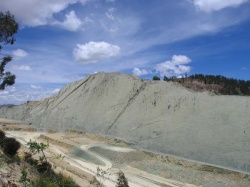
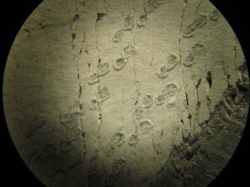
It looks like they may still be excavating the area, clearing the lower part of the rock face to reveal more footprints.
It was interesting because there were so many footprints and the wall was practically vertical. A mural on the wall of the viewing area gave a whimsical interpretation of footprints being made by gravity defying dinosaurs with gecko feet abilities.
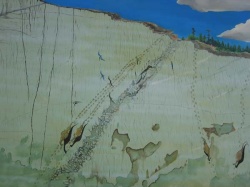
In reality the rock face had been part of a lake bottom. I couldn't quite figure out from the museum how it went from lake bottom to wall. I guess it must have been due to seismic activity forcing it up into the sharp angle.
We decided to leave Friday morning for Potosi. We'd found out that there was a huge protest scheduled for Friday afternoon. Although the protest might have been interesting, we didn't feel like getting caught in the middle if violence broke out. Back at the hotel, there was a news report that people had set a state worker's vehicle on fire in front of the theatre.
Friday morning was still relatively calm. People were lined up outside a building with white shirts. The office was giving free silkscreen prints calling for Sucre to be the capital.
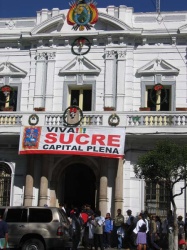
I guess the march went fairly peacefully since the news just showed groups of people protesting. It seemed like more conflicts happened in La Paz instead.
Bus Ride to Sucre
12 December, 2007, 11:04 am in "Bolivia"
 I don't want to be one of those travelers who end up writing too much about bus trips, bus stations and other transport related items. But this one needs noting.
 We had Andres at the Andoriņa Hostel reserve seats for us on the Flota Copacabana bus "cama" (bed) to Sucre. The bus company he usually books with had one of their busses break down so weren't going to Sucre that night. Our other choice was to stand by the road and flag down a bus. All the buses from Santa Cruz to Sucre use the highway that goes by Samaipata. However, there was a risk they wouldn't have room. Andres told us our reservations were set and we should be at the tranca a police toll booth, at 7PM for a bus that would arrive around 7:30. He also mentioned, since they don't usually pick up passengers, we should be sure to wave and jump in front of the bus to make sure they noticed us.
In the afternoon we walked down to the road to find the tranca. There was none in sight. We asked some people and an American hostel owner rushed up to inform us that the tranca didn't exist anymore. Consequently the buses wouldn't stop there. We were also told that all the buses now stopped at the turnoff to the village.
We told Andres this and he went and checked with the police. It turns out that 5 days before, the tranca had been removed because the toll collected there went to La Paz and Santa Cruz wanted autonomy (a very hot topic right now). So a new tranca would be built at some point and the tolls would stay in the province. For us, the most important thing was that we'd be catching the bus at the turn off which was a shorter walk anyway.
To be safe, we reached the road at 6:45. The buses started rolling by a bit after 7. We positioned ourselves with Rowshan a block ahead so he could read the bus name and signal to me to stop it (if it didn't stop for him). By now it was dark. 7:30 passed... and 8:30. We wondered when we should give up and go back to the hostel. A Flota Copacabana bus went by and didn't stop. Rowshan ran down the street and managed to ask if it was the bus "cama", as it slowed for a speed bump. The conductor said it wasn't and that the bus "cama" was behind somewhere.
Our bus finally showed up about quarter past 9. The conductor handed us our tickets which were for the 2nd row from the back.
Now, one of the tour agency guys we talked to (who informed us of the possibility of just flagging down busses by the road between 6 and 8:30 PM) distinctly said the buse only sold tickets if they had seats so we wouldn't have to worry about getting on a bus and having to stand in the aisle all the way to Sucre. He was wrong. As we picked our way through the bunches of people sleeping in the aisles, I was glad we'd bought tickets in advance with seat numbers. Our seats, however, contained an old man and a woman with a baby. The conductor kicked them out onto the floor. I offered to leave the bus (another day in Samaipata definitely would not be a sacrifice) if the conductor would refund our money, but he said that wasn't possible.
The bus made a meal/bathroom stop. Rowshan looked at the other buses and saw they were equally or more packed. He asked a fellow passenger about the price (since it was the most expensive ticket we'd bought in Bolivia and the other night buses we'd taken never had people sleeping in the aisles). The passenger said it was a difficult road and we were getting into the holiday season.
Late at night, or early morning, the bus stopped again and remained that way for a while. Soon we heard the metalic clanking of tools and realized they were changing a flat tire. This took an hour or so. We eventually got back on the road only to make another stop (for breakfast) during which they changed the tire again (though maybe it was just from a spare to a regular tire).
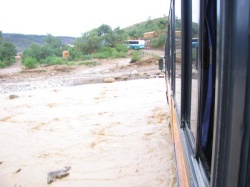
A couple hours later, the bus stopped again. This time things didn't look too good. There was a long line of buses and trucks stretching up the road in front of us. All had their engines stopped. People were walking back and forth along the line of vehicles. I got out and walked up the road, recognizing the buses that had passed us earlier as we had waited in Samaipata. In front of the first bus a rushing river was blocking the road. Lots of people stood by the river gazing at the opposite shore.
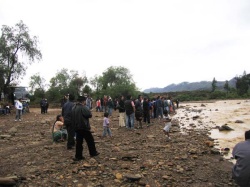
I surveyed the river looking for a way to get across by foot. I saw one point where we might have been able to leap from one rock to another but definitely not while carrying our bags. Further down the street, on the opposite side, was a village. The surroundings had sparce bushes, hills and cactus. I went back to the bus and Rowshan took a walk to see the river. Then he came back and we waited.
...and waited...
Finally, I guess the bus in front decided the water had lowered enough (or was just tired of waiting). The engines started up and the drivers honked signalling to their passengers.
One by one the vehicles plowed through the water and once again we were on our way. It was probably around 9, the time the bus should have been in Sucre.
The rest of the trip was fairly uneventful. We arrived in Sucre 4 or so hours late but very happy to be getting off that bus.
Las Cuevas (Samaipata)
11 December, 2007, 03:03 pm in "Bolivia"
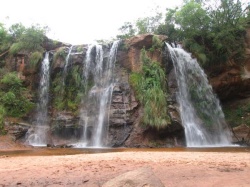 Our last day in Samaipata started out OK but a strong wind swept in and soon it was pouring. By the time we'd visited the small local museum, it had stopped, so we headed off by taxi to Las Cuevas.
The waterfalls are on private land, shut off from the street by a huge gate. At the gate stood a skinny kid who demanded 10 Bolivianos from each of us. My first thought was, "Yah right! This is how the local kids make some extra cash, hanging out in front of the gate charging tourists." However, it was private property so it would make sense that the owner would charge. The kid didn't have change, or a ticket, or even a receipt. He offered to take our 50 Boliviano note and then when we returned to the gate on our way out he'd give us change and a receipt. We took our money and told him while we were in the park, he could go find change and receipts and we'd pay him when we came back out.
We walked in. We were the only people there. The weather had become a mix of sunny and slightly rainy. The waterfalls were gentle falls, over reddish rock and spiky green plants. Below were shallow pools and soft red sand. Other paths led to 2 more waterfalls.
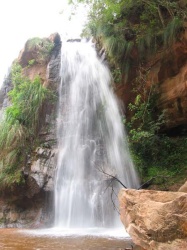
The third was located down a quiet emerald forest path.
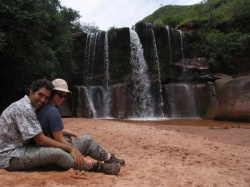
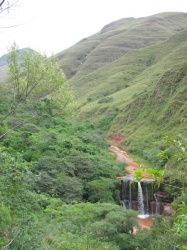
There were butterflies, birds and we even saw a flock of parrots. We played around in the waterfalls for a bit.
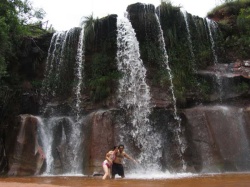
We could have continued on a path that led along the river but I was worried about finding a taxi back into town (20km). As we were leaving, we passed a large group of people coming in. The kid at the gate had a handful of cash. We paid him and he gave us change. Then he asked if we wanted a receipt. I said sure. With a serious air, he walked over to a cart and produced a receipt pad. Very professionally, he filled it out, sneaking glances at previous receipts to make sure he was doing it right, writing Bienti Bolivianos (I found it encouraging that native Spanish speakers can't tell the difference between the 'B' and 'V' sounds either).
My worries about catching a taxi were unfounded and soon we were back in town with a lot of time to spare.
Powered by My Blog 1.69. Copyright 2003-2006 FuzzyMonkey.net.
Created by the scripting wizards at FuzzyMonkey.net..
(Code modified by Rowshan Dowlatabadi)
Created by the scripting wizards at FuzzyMonkey.net..
(Code modified by Rowshan Dowlatabadi)