

Squishy Green Paradise
10 December, 2007, 02:51 pm in "Bolivia"
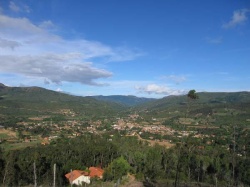
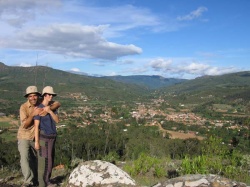 Samaipata is paradise. It is a small village surrounded by heavenly green mountains. Beautiful views abound.
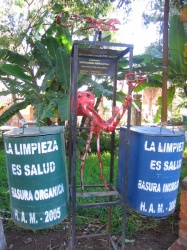
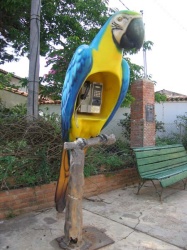
 It has a shade filled square with trees and odd animals constructed from scrap metal, Inca ruins a few km away, and waterfalls a little farther.
I put Samaipata on our list of places to visit because it has the part of the Amboro National Park which contains cloud forests. As I've mentioned before, I LOVE CLOUD FORESTS.
We took an overnight bus from Cochabamba to Santa Cruz. Late into the night, the bus became sweltering and we began to drip with sweat. We'd descended into the tropical jungle area from the land of eternal summer.
Originally we were going to stay in Santa Cruz but after being a bit disgusted by prices (and not being very impressed with what we saw of the town) we decided to continue on to Samaipata. The road was beautiful. We left the heat and humidity and climbed just enough into the mountains to find ourselves surrounded by green trees, rushing rivers and an occasional cascade.
We reached the village past lunchtime but managed to find a bite to eat (though not a very good one). One thing that I immediately noticed was that lots of other people have decided that Samaipata is paradise. There are lots of foreigner run businesses, restaurants, hostels, and even a German bakery.
Having a bit of time, we took a short steep hike up a hill (past, as the info guide at the hotel we were staying at put it, "The rich peoples' houses" to a mirador above town. We could see lots of birds as well as the cloud draped mountains of Amboro in the distance.
We scheduled a tour to Amboro for the next day (you can only go with a guide and going with a tour is cheaper than hiring a taxi and independent guide). Early in the morning, we were awakened by a crack of thunder and a downpour. We hoped it would finish early enough that we'd be able to go on our hike, but by 9AM, it was still raining. The tour was rescheduled for the next morning.
By 11 AM it had stopped raining so we decided to walk to the ruins (El Fuerte), an 8.7 km hike, most of which followed a dirt road up the mountains, which was beautiful.
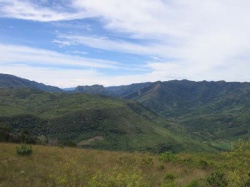
The sun came out and the road quickly dried. At one point we had to jump over a stream. As we got close to the ruins we saw a gate closing off the road. We walked around it, thinking the ruins might not be open when we got there (even though the sign said they were open every day 9-5). Then a motorcycle went by followed by a few cars. We reached the ruins a few minutes before they opened--giving us a few minutes to rest before hiking up a path to the top of the hill. The ruins have been combined with an eco-path providing views of the surroundings and a sampling of the different environmental features of the area. The ruins had several different sections. It had also been used by several different groups of people: the Mojocoyas and Chane, Guarani, Incas and finally, the Spanish. The first section was based around a huge rock outcropping. There were shapes, patterns, drainage canals and niches carved into it. This was viewable from wooden viewing platforms and walkways.
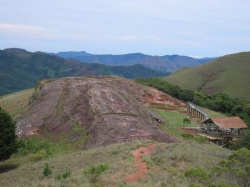
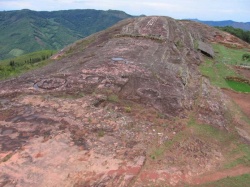
Other parts were made up of stone walls.
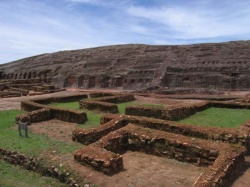
There were also a few terraced gardens. One path led down the hill a bit and terminated at a deep stone-lined hole. No one knows what this was used for but it is speculated that it could have been for punishment or hiding treasure.
After meandering around the ruins, admiring the flowers and nature as well as the stone structures, we headed back down the hill.
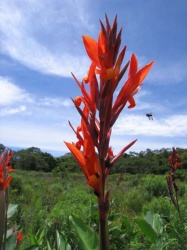
This time we found a shortcut (which was confirmed by a local woman). This fortunately, took us off the now sunny and shadeless road into a damp green forested area. The path ran along a river and spit us out on the highway next to a cascade, cutting a few km off our hike.
Today, fortune smiled on us and the day was beautiful. Our tour agency picked us up at 9 and we headed into the mountains, through a rural area, having to avoid an occasional cow. The driver stopped the car at a gate and we hiked in from there. This part of the trail, although it yielded some beautiful views, was fairly dry and pastoral. But, scaling another fence brought us into the forest. The ground was damp and soft. Moss grew on the trees and mushrooms and fungus grew out of sot rotting tree trunks.
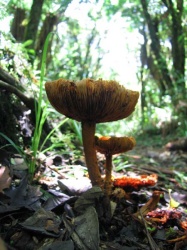
Everything seemed soft and squishy: the moss on the trees, the rotting tree trunks, the ground made of decomposing plant matter, and the numerous patches of mud.
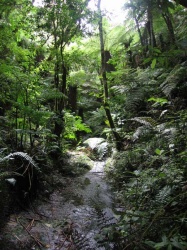
We climbed until we reached the top of a hill and were able to see the mountains to the north, green with some red cliff faces visible.
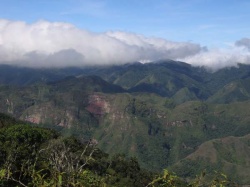
As we climbed out of the forest it felt like we'd climbed a tall tree and were able to see the soft cushion of forest tree tops below us.
Our guide led us back into the forest and the welcoming shade. We descended and reached the giant fern forests. Huge ferns, some 15 feet or taller, grew there, their leaves making huge light speckled umbrellas above us.
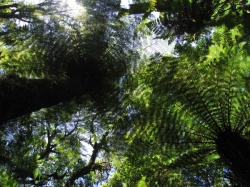
They were from a prehistoric time. Their trunks and roots were above ground... also soft and squishy. Their huge fans of leaves made them seem incredibly top heavy. They filtered the light into tranquil shadows beneath.
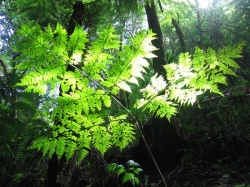
The forest was full of them. There were also climbing vines, a huge tree related to the tiny mint plant, butterflies and birds. We even saw a baby snake.
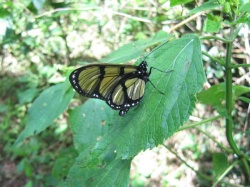
For some of the hike we followed a cascade. Other parts we found ourselves above the trees. The woods had that beautiful damp green smell that makes me think of the Pacific Northwest. I seriously considered joining the hoards of foreigners who stayed in Samaipata.
We had lunch in a clearing beneath a few giant ferns and then continued our hike. We saw some animal tracks and I managed to slip down a muddy slope even after the guide had spent a minute digging a foothold for us.
Back in town (which we reached in the in between meal time of 4:30) we had some ice cream to hold us until the restaurants opened at 6:30. We went to a local restaurant with no name by the side of the highway. It was surprisingly good: hot flavorful soup, rice, salad and barbecued chicken.
The hostel we are staying at is Andorina, owned by a Dutch-Bolivian couple Andres and Dorina. It has nice aesthetically pleasing rooms with earthy tiled floors and Andres' photos of people and places he's visited while traveling. Our room has a little balcony. It is a comfortable, clean and friendly place.
It is hard to leave this town. Of all the places we've visited so far, it attracts me the most (as a place to live).
[ View 1 Comments
|
]
Cochabamba and Huayculli
8 December, 2007, 08:26 pm in "Bolivia"
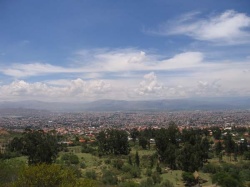 Cochabamba reminds me of someplace--or maybe a combination of places. Sometimes New Orleans, sometimes Chiang Mai, sometimes some other places but I'm not sure where. It is a comfortable, almost tropical place and though they call it the city of eternal summer, it makes me think of spring. It is a pleasant place, not for an abundance of tourist sites but rather just as a place to hang out. It is nice to wander around. There is a lot of street life. I guess due to the weather, everything can be done outside, so it is. According to Wikipedia, is the largest open air market in South America. We also found the largest market devoted solely to bananas that we've ever seen.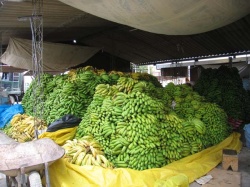
The parks are full of people and so are the sidewalks. The city has nice colonial buildings as well as a pretty natural setting. To the North, you can see snow capped mountains and to the East, cactus covered hills.
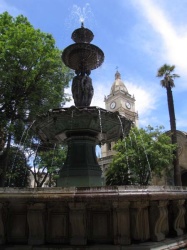
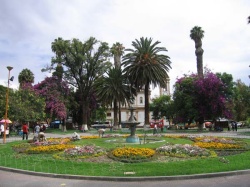
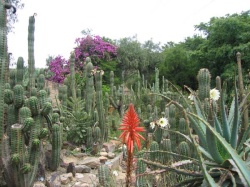
We ate breakfast on a street corner and then walked to a botanical garden, arriving just in time for a siesta. It wasn't a pristine, well-groomed palace garden but rather a slightly wild garden which invited people to sit on the grass and listen to the large number of birds singing in the trees.
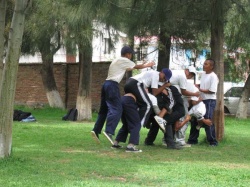
Guys from a colegio were playing a game Rowshan recognized from Iran and Turkey, "Long Donkey," where 1 team leap frogged onto the backs of the other team and tried to make the "donkey" team collapse. Rowshan asked the players the name of the game which was (ChoroMoro).
After walking around the garden (and napping on a bench), we headed north of the river. It looked like a swanky region with fancy restaurants, bars and clubs. We went to a cultural center (with a more groomed palace garden) to see an interesting art exhibition of contemporary artists.
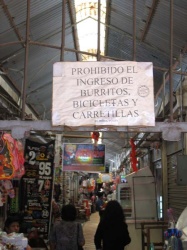
While walking back to the center, we noticed bunches of buses had been parked to block the main streets. I heard Bolivians were always protesting so I figured this was another transportation strike. The next day there was a huge protest march about the new Bolivian constitution. A lot of businesses were closed. We even saw what we thought was a donkey protest which we figured was due to the exclusion of donkeys from La Cancha market.
It turned out to be just a group of donkeys on their way to hassle drivers who stopped in the crosswalks.
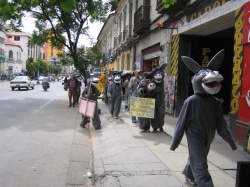
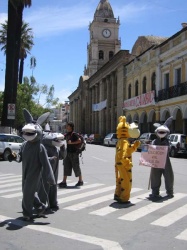
Cochabamba Traffic Donkeys
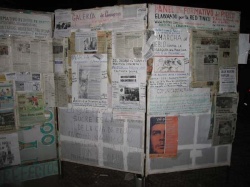
In the plaza, there is an information board (sponsored by a political organization) and all day Friday, there seemed to be a heated political discussion going on next to it. (Later, we learned we are in Bolivia at a very heated political time with a controversial new constitution, and a push for moving the capital back to Sucre.)
On Thursday, we hiked up a hill overlooking the town. Rowshan decided to return to town and go visit a ceramics village while I finished the hike.
I (Rowshan) had a map with ceramic pictures on it which I had taken from the information office. I took a shared taxi to Tarata which was about 35 KM south of Cochabamba. The actual village where they do ceramics was Huayculli 8 KM east of Tarata. Since the scenery was beautiful, I decided to walk.
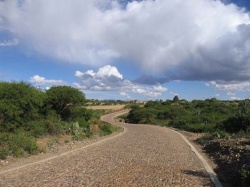
During walking I saw broken pots which was a sign that I was on a right track. When I saw the piggy banks, I was sure that I would see the ceramic village.
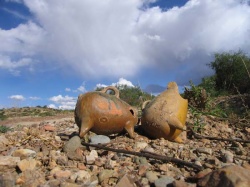
I asked three kids sitting next to the road about the village and they said that I was there. The strange thing was that there were only a few people in the village and the plaza was completly empty.
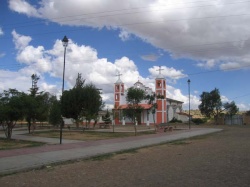
I saw a family and asked them where I can find ceramics and see how they make pots. The told me that all the people were at a fiesta and nobody was working that day which I had realized. Any way, since I had walked 8 KM, I did not want to give up.
Almost all the houses had kilns in their yards with raw clays in another corner.
I saw a young guy in one of the ceramic houses. I said "Buenas tardes" and the guy came to me and asked what I was looking for. I explained that I was also a potter and would like to get some information about how ceramics are made there. Irvine (name of the person) walked me inside showed the kilns and answered all my questions.
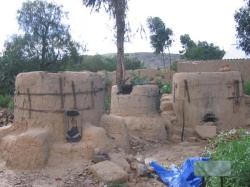
He said that all the family members do ceramics. For firing they use eucalyptus leaves in a mud made kiln. They use kick wheels (with broken parts) and molds for making their pots.
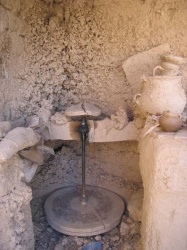
While I was walking back, I saw black smoke coming from a kiln in another house. I walked there in order to take a few photos. However, when I asked they did not allow me since I was not going to buy anything. I found another house where a man was kicking the wheel with lots of clay on it. I told him that because of travelling, I could not buy anything but I offered him some money and he allowed me to take photos and also use the video camera. Morales was very fast and in 2 minutes he had finished two bowls.
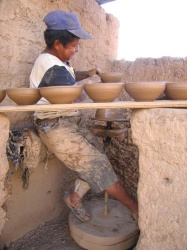
In Cochabamba the dishes and vases of Huayculli village can be seen everywhere.
In the evening there was a free concert featuring the municipal brass band and Llajtaymanta, a traditional Bolivian band which mixed panpipes, close harmonic singing and charango with pop influences.
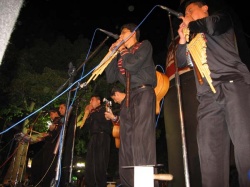
I enjoyed their South American take on "The Lion Sleeps Tonight". Everyone seemed to be having a great time. I had to admire the ingenuity of a kid who transformed his sweatshirt and the bars under the stage into a swing.
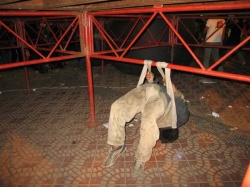
Lots of people sang along and the children danced.
Eating in Cochabamba
8 December, 2007, 05:26 pm in "Bolivia"
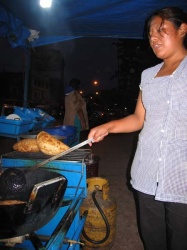 We seem to be having difficulties getting a grip on the Bolivian eating schedule. It seems we get cravings for certain foods at the wrong times. The salteñas (meat, vegi, potato and egg stuffed baked bread things, always a little burnt on the top ridge) seem like a great evening snack to me but they are actually day food. We want dinner/lunch around 3 or 4 but dinner time is later and lunch is earlier. Between 2 and 6, just the fried chicken places seem to be serving.
 I guess we are not alone in this problem because the tourist info office, as part of a very nice map of Cochabamba, included a schedule of food. From 6-8 AM, one should eat food like api and pastels (more about that later) or buñelos (fried dough). From 10-11:30 AM salteñas, locotos rellenos (stuffed peppers) and papas rellenos (stuffed potatoes) are recommended (too bad I don't feel like lunch at 10 AM). From 12:30-2 PM it is lunch time. We are always really thrilled to be looking for lunch at this time because the super cheap set menus are available. Dishes like picantes, sopa de mani, chicharron and conejo lambreado are recommended by the office of tourism. From 2-4 you are just not supposed to eat, I guess, since no dishes were listed between these hours. From 4-5 PM humintas (tamales), sandwiches, empanadas, ice cream and planchitas (grilled meat) are suggested. From 7-9 PM silpancho (a flattened piece of meat served on rice and potatoes with 2 fried eggs on top and salsa) and some other dishes were recommended and finally from 11 PM to Midnight it was time for anticuchos (kebabs). Eating here is an acquired skill.
On our 2nd day in Cochabamba, we ended up talking to a Bolivian cafe owner who grew up in Virginia. He said, "Don't visit the sights or museums. You'll be disappointed. What you should do in Cochabamba is eat. The food is so good here, I eat things I would have never eaten in the states... like tongue." We explained our food finding difficulties and he pulled out a brochure which contained photos of various dishes and the names of restaurants that had won a city wide competition in their preparation. My first thought was someone needed a food stylist and a better food photographer since all the dishes looked really unappetizing.
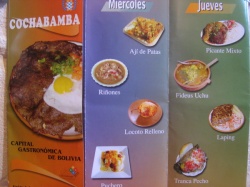
Also, the brochure neglected to mention the addresses. Fortunately we found another brochure at the tourist info office. This one was printed on a gradient of orange mixing with green mixing with purple creating a rainbow of unappetizing colors. Printed on this were daily recommendations for food, each complete with a photo of something that looked like it might have been previously digested. At least this brochure had addresses which, with a bit of searching on the keyless map, we were able to find a few of.
Our first local dish was picante. It was pretty good: meat of your choice and potatoes in a spicy pepper sauce served with rice and a pile of reconstituted freeze dried potatoes, called chuño, in case the other potatoes weren't enough. Chuño, when I've seen them in the market, look like the potato equivalent of brie, because somewhere in the drying process, they end up turning a moldy white color. Cooked, however,they looked coated with black mold. Strangely enough, they just tasted like potatoes.
The food we really got hooked on were pastels. Although, scheduled for the early morning hours, we found them in the early evening on the street corner near our hotel. A series of blue tarps were strung over about half a block. Underneath were tables, benches and a couple gas stoves. "Oh look at those!" I excitedly gestured at some big puffy fried dough things. Rowshan, who had been unable to find dinner, decided whatever they were, they would do (I'd been sick so didn't have much of an appetite). The huge pockets were mostly air with a little cheese melted inside. However, when they were fresh, hot and sprinkled with powdered sugar, they were delicious. Traditionally they are eaten for breakfast with api, a drink resembling cream of wheat mixed with chicha morada (a fruity tasting drink made from purple maize). This became our breakfast of choice.
The dish I really wanted to try was sopa de mani (peanut soup). Seeing one of the restaurants on our list featured this as part of their set lunch, I tried it. It didn't taste like peanuts at all and the rest of the food in the set lunch wasn't much better (to the restaurants credit, it had one the silpancha contest not the peanut soup contest. Due to faulty meal planning, our last 2 dinners were sandwiches bought from street sandwich grills,a few cheese empanadas and ice cream.
Though there were lots of cafes in Cochabamba, the coffee, according to Rowshan, left a lot to be desired. So did the hot chocolate. Finally I got a good submarino (chocolate bar melted in steamed milk) from a cafe called Casablanca which also served great ice cream with chocolate sauce (pure melted chocolate) or fresh strawberries. They also played cool music.
We didn't succeed in finding a fresh salteña to eat (when we wanted it) until the morning after an all night bus ride to Santa Cruz. They were hot and juicy with a crunchy bread crust that managed to hold everything without getting soggy.
Powered by My Blog 1.69. Copyright 2003-2006 FuzzyMonkey.net.
Created by the scripting wizards at FuzzyMonkey.net..
(Code modified by Rowshan Dowlatabadi)
Created by the scripting wizards at FuzzyMonkey.net..
(Code modified by Rowshan Dowlatabadi)