

Valle de la Luna
2 December, 2007, 02:04 pm in "Bolivia"
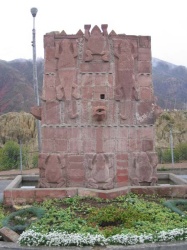 A thick layer of clouds had capped the valley, covering La Paz. It had rained the night before, but we'd planned on visiting the Valle de la Luna. The weather is so changeable, no matter how it starts out in the morning, at some point it will probably rain. We waited for a while for a microbus containing one of the numbers listed on a brochure we got from the tourist info center. Eventually we gave up, walked further down to a main rotary and looked for any mini or microbus with the word Mallasa on it. We witnessed a fender bender and a few narrow misses and finally caught bus 43 which went to Mallasa but wasn't mentioned in the brochure. The bus was packed which made sense since it was probably the first bus in an hour going to Mallasa. Unable to see much out of the windows, we were blindly carried off to the hills. Fortunately the driver guessed that we were headed to the Valle de la Luna and let us know when we got there.
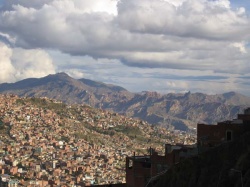
 From La Paz, we had been able to see some of the types of rock formations that make up the Valle. A lot of the hills around the city have odd eroded rock pinacles.
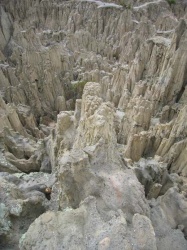
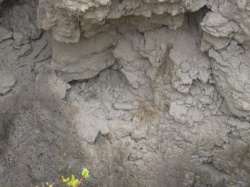
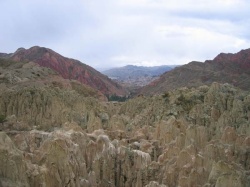
The Valle is up a hill from S. La Paz. It is an area full of pinacles made up of something between mud and rock. Though you can see the pinacles all around the area, the Valle site has paths constructed so one can walk around, above and between the pinacles. Signs point out formations like the "Good Grandfather" and the "Lady's Hat".
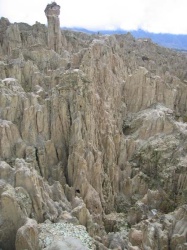
It started raining while we were there and the path became muddy. In one area, the trash people had thrown down had become completly covered with mud which had dripped from the pinacles above.
In the distance, the red hills reminded me of Utah.
After doing the circuit we walked down the hill into town. The ceramics workshop Rowshan wanted to see was closed so we looked around the town then walked back up the hill. We decided to hike a trail called the Sendero de Aguila. It followed the edge of one of the red mountains and was in an area, Amor de Dios, which rumor has it was an area where Che Guevara hid out in 1967.
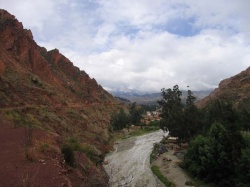
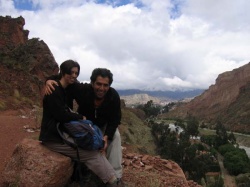
Walking down toward the path, we cut through a cactus park. The path was above a river and had beautiful views of mountains on the other side, and swanky houses below. The sun had come out by the time we got to the mirador which looked out over the city. We couldn't get to the mirador because the path up it had been washed away. We walked down into the city and caught a microbus back to the center, stopping in the swanky bar/embassy area--not very lively since it was a Sunday afternoon.
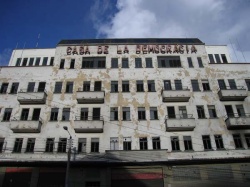
As we walked up to check bus times to Cochabamba, we noticed a derelict building with all the windows broken. At the top in big letters was "Casa De La Democracia" We found this very ironic.
Tiahuanaco
1 December, 2007, 05:24 pm in "Bolivia"
 The minibuses to Tiahuanaco are way up a hill. I don't blame the minibus companies for it because the streets below are packed solid with cars getting up the hill, so walking to the station was probably quicker than going in a vehicle.
Tiahuanaco is the most important archaeological complex in Bolivia. It's about 1.5 hours from La Paz, close to Lake Titicaca. The Tiahuanaco culture lasted for quite a while. From what I can tell, what caused their demise is still a mystery.
The ruins had temples and pyramids as well as carved stone monoliths. The stone carvings we saw seemed to all be humans but with very stylized faces.
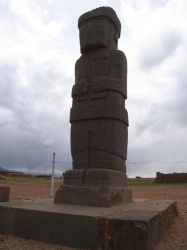
There were 3 monoliths in the ruins. All represented figures holding something in each hand. They had interesting patterns carved into their clothing. There was a cool sunken temple with all the walls lined with stone heads (though many of the faces were too eroded to know for sure that they were heads).
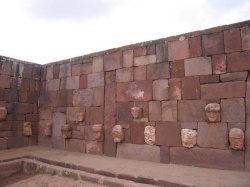
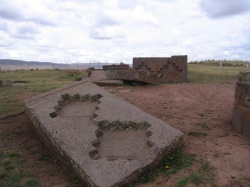
Other areas of the ruins contained stones carved with more abstract patterns.
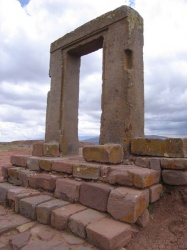
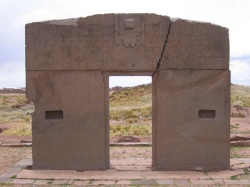
There were also a couple stone doorways, one which had an interesting sun figure (I think) carved in the top.
The area where the ruins were was flat antiplano, but in the distance were hills and mountains. Also, in the distance were thunderclouds and we were rained on now and then as we explored the ruins. The complex consisted of a very minimalist stone museum (containing a monolith and a couple other stone items); the main ruins complex with the ruins of a pyramid and several temples; a more in depth museum with chronological examples of ceramics, stone, and bronze; and the ruins of another pyramid, Puma Punka.
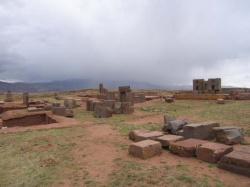
The whole area looked like it is still being excavated.
We caught a minibus back to La Paz. As we reached the hill overlooking the city, Rowshan saw that the mountains were sort of visible so we jumped out so he could take some photos.
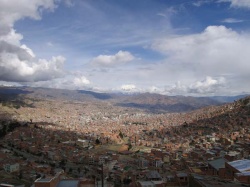
Then we walked down to the city--a long walk which as we got closer to the center ended up taking us through packed market streets including a Christmas market. It's odd to think it is December. Thee isn't the overload of decorations everywhere like in San Diego. And... it is summer here.
La Paz
30 November, 2007, 05:26 pm in "Bolivia"
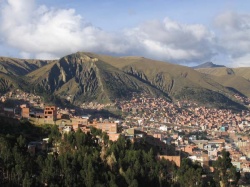 The first thing we did in the morning, before even eating breakfast, was to pop into Immigration to attempt to extend our visas. I thought it wouldn't happen (since they were a day away from instituting the new visas for US citizens policy), but within 5 minutes of asking (2 minutes of which was running across the street to get photocopies) and a whopping 15cents later (cost of photocopies), our 30 day visas had been extended to 90 days. Rowshan was so happy he considered running back and suggesting the Bolivian Government put out a tip jar.
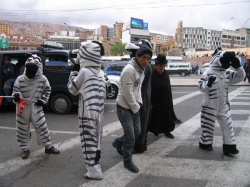
We decided to have breakfast in the market. We headed to the busy main street and Rowshan was about to J-walk when he was sternly reprimanded by a zebra. A quick survey of the street revealed a lot of zebra-costume clad individuals. Some carrying signs, some holding barrier chains, all set on preventing J-walkers. And they were serious... physically barring the way of people attempting to race in front of the cars and then gleefully skipping across the street when the light changed.
There was also a donkey who would occasionally run in front of cars to demonstrate what not to do.
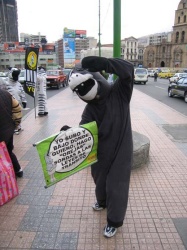
I spent the next 5 minutes scolding Rowshan for not paying attention to the crossing zebras.
We spent the day visiting a lot of museums. The first stop was the Ethnography and Folk Art museum. There were displays on weaving, ceramics, masks and feather arts. It was really beautifully set up with nice presentations, videos on flat screen TVs and a broad range of pieces. It was also free. The National Art Museum had lots of colonial paintins which I'm rather sick of. However, there was a really nice section on 20th century Bolivian art which gave me the suspicion that La Paz is hiding a rather sophisticated art scene somewhere.
Around mid-day we hit the San Francisco Monastary.
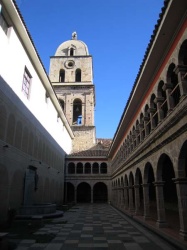
The ticket price included a guide who gave us a tour using a combination of Spanish and English. There were more colonial religious paintings. However, one interesting thing I did learn was the reason for all the triangular shaped Virgin Marys was that the symbol for Pachamama was a triangle so the indigenous people of the Andes related well to the image of a mother and child in a triangular shape.
We climbed up on the sloping roof where a 2nd belltower was supposed to be built but the plans were scrapped when the building sloped.
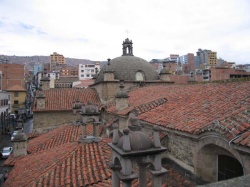
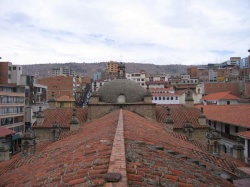
One belltower had been built and it contained the clarion bells. The roof had been covered in curved red tiles that had been made by wrapping the red clay around indigenous workers' legs.
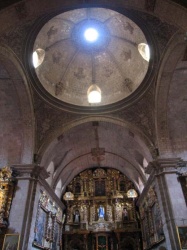
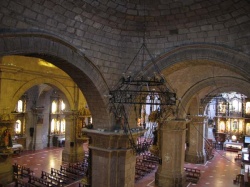
Coming down from the roof, we looked at the inside of the cathedral and then went down into the crypt which housed several containers of ashes of heroes and other important people.
We had a huge lunch at a lunch restaurant, then went to the Museum of Bolivian Musical Instruments. We had fun looking at the various instruments including a case of small Bolivian harps, giant zamponas (I get dizzy trying to play a small one), drums, charangos of various designs and other interesting instruments. There were a few instruments available for trying out: a spam can monochord, marimbas, drums, the inside of a piano, chimes, and a set of wine bottles filled with different amounts of water. The last museum we went to was a small archaeological museum containing lots of pottery and stone.
A day of walking around the lower part of the city had given me a feeling of asphyxiation. So in the afternoon we climbed up steep streets and stairs to escape the crowded lower streets and exaust.
[ View 1 Comments
|
]
Powered by My Blog 1.69. Copyright 2003-2006 FuzzyMonkey.net.
Created by the scripting wizards at FuzzyMonkey.net..
(Code modified by Rowshan Dowlatabadi)
Created by the scripting wizards at FuzzyMonkey.net..
(Code modified by Rowshan Dowlatabadi)