

Going to La Paz
29 November, 2007, 05:26 pm in "Bolivia"
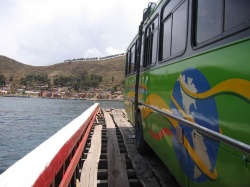 Today we boarded the bus to La Paz. It is a pretty trip starting out rising above Lake Titicaca and crossing hills and fields. Women in their tall felt bowler hats, full skirts, aprons and shawls would flag down the bus and board carrying large bundles in colorful woven cloths. There were some men who boarded, too. As the bus pulled into a town called Tiquina, almost everyone got off the bus. Then a conductor told us to get off. We'd reached some straights and I guess the passengers were supposed to take a different boat across, then meet the bus, which was carried across on a barge. One of the other Americans on board objected to being separated from his luggage. A few Bolivians also didn't seem to have any intention of leaving the bus. The conductor, I think, decided he didn't feel like arguing so he told us we could stay on the bus except we had to close the curtains. The bus drove onto a rickety wooden platform, making us wish we had taken a passenger boat instead. We peaked out from behind the curtains, so we could see the other busses floating across the straights.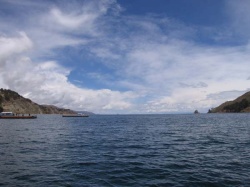
On the other side, everyone got back on and we continued on the road to La Paz. The bus driver played nice traditional Bolivian music featuring flutes and vocals--kind of what I'd expect to listen to while crossing the antiplano. It was a welcome change from the combination of 80s hits, Grupo5 songs about cerveza and the huayno music with its repetitive harp passages and vocal lines, popular in Peru.
The landscape was mostly fields. Sheep tied by the side of the road would startle whenevver the bus honked, pulling at their ropes. As we approached La Paz, the empty fields were quickly replaced with lots of buildings. Rowshan pointed out that the buildins seemed to be built better than those in Peru. More were built with bricks. However, many had a brick 2nd story built on an adobe first story which didn't seem very secure.
One area had an abundance of church spires poking above the multitude of buildings.
Then we turned a corner and found ourselves looking down on La Paz. It is in a valley surrounded on one side by mountains. the bus descended into the valley and we got off near the center and took a taxi to a hotel. We haven't been in a big city for about 1.5 months so it was a bit startling. There is lots of traffic and lots of exaust. La Paz is a couple hundred meters lower than Copacabana, but between the exaust, altitude, and the fact that the whole city seems to be uphill, I found myself very winded.
As we were looking for a place to eat dinner, and not being very successful, we wandered into the "tourist ghetto" and found ourselves on the street known as the Witches Market. There were lots of stands selling herbs, charms, and an unreasonable number of llama fetuses in different stages of development. This has made me wonder if there are people who work as llama abortionists to supply the witches markets. I asked one saleswoman what the llama fetuses were used for and she simply said, "Pachamama" (the Incan earth goddess). We wandered past souvenir shops and then decided to find a cafe. At this point we discovered that Bolivians smoke a lot more than Peruvians. Most of the cafes were terribly smoke filled. Eventually we found an arty cafe on a very cute cobblestone street filled with colonial buildings. The cafe had a nice courtyard with tables next to a rose garden. There were interesting pictures on the walls and they were playing traditional Bolivian music. Rowshan had coffee and I had some very tasty hot chocolate. Then we walked down the street noticing the Museum of Musical Instruments, the headquarters for the National Ballet Folklorico and the Municipal Theatre around the corner.
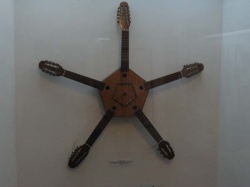
We had managed to stumble upon a little art district.
Isla del Sol
28 November, 2007, 04:13 pm in "Bolivia"
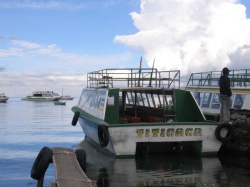 We are on the boat back from the Isla del Sol. We got up early, ate breakfast and caught the 8:00 boat to the island. It was packed and about 20 minutes out, it stopped. One of the boat guys came up to the roof where we were sitting and requested 4 volunteers to sit on the edge of the roof in front of the guard rail enclosed seating area to fix the ballance of the boat. The boat still didn't start moving so we speculated that they had overloaded it. As another boat pulled up, we thought this definitely was the case and I got ready to move to this other boat. Instead, a couple more passengers hopped from this 2nd boat onto our overloaded boat and the now empty 2nd boat sped back to the shore. Our boat started moving again.
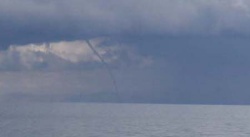
It was a breeazy ride but the sun was warm. In the distance we could see a large flat cloud bank and dark patches of rain. Then Rowshan noticed a water spout stretching from the water to the cloud. It faded and then another, much larger one, formed. It was strange because the weather was so calm and the lake was smooth.
The island is fairly rocky and has only a few areas of trees, probably planted. There are lots of sheep grazing on patches of grass sprouting between the rocks. The port is in a tiny town, mostly consisting of restaurants and businesses selling snacks and drinks to tourists.
We walked through the town and were stopped by a man selling tickets to the museum and ruins in the North. The museum was one room containing ceramics, bones, and other artifacts, mostly found underwater. It would have been nicer if it had more information about the sites on the island. We headed up the path which revealed stunning views of the deep blue clear lake, rocky hills of the island, and, off in the distance, snow-capped mountains barely revealed through the clouds.
We passed through the yard of the primary school which had donkeys grazing and some piglets sunning themselves on the path. We stopped at a sacred rock. I think it was supposed to be a grave of one of the Incas.
The Isla del Sol is the setting for the Incan creation myth. The first 2 Incas, the son and daughter of the sun, were supposed to have descended to earth and landed on a sacred stone on the island. Then they went on to create the Incan race.
A stone path had been built across the island-- a gringo trail since it seems only tourists (and people selling things to tourists) use it. But it is a nice path, running along the ridges of the hills that make up the island. Eventually we came to what were probably the largest ruins on the island. There was something called a "sacrificial table."
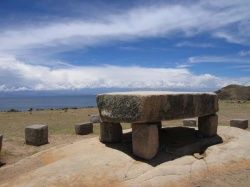
Across from it was what I think was the sacred stone of the legend but am not entirely sure.
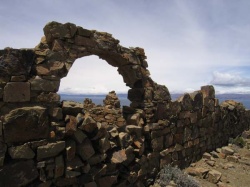
The ruins were a series of walls, window areas and doorways made of rocks.
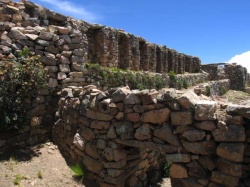
I guess after seeing the ruins in Peru, one gets kind of jaded toward Incan ruins. But these definitely had a beautiful location. The island reminded me a little of Samos, Greece, and the Princes Islands in Istanbul, except with less trees. All the islands shared the combination of ancient ruins, hot sun, and beautiful bays.
Back on the crest trail, we walked up and down. There were occasional ruins of house and a few non-ruined structures.
One one hill there was a llama and baby.
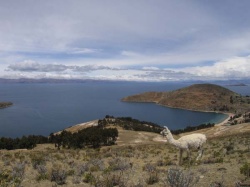
We ate lunch at the top of another hill. In the distance the metal roofs of a town across the lake glittered silver.
In a couple hours we reached the south of the island where we had to buy antoerh ticket for the ruins in the South... most of which we couldn't figure out how to get to.
We reached a village and headed down the "Inca Stairway". Every now and then, we had to jump to the edge of the path as a kid chased several donkeys down the stairs. Several groups of donkeys overtook us as well as a few llamas. When we got to the port, it was full of donkeys and llamas. I guess they were waiting for supply boats. We had some time to kill before the boat left so we walked along the shore to see a huge reed boat with 2 puma heads.
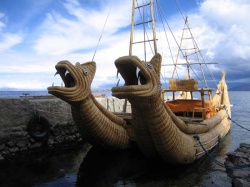
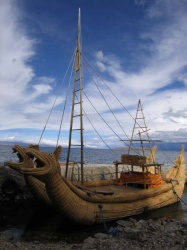
To get there we passed an area where people were working on another reed boat. They had strings laid out to form guides and had placed some bundles of reeds on the grid. They were bending, flattening and braiding reeds, but I think this was to make the little reed llamas everyone on the island sells. We asked how long it takes to make a boat and were told 9-12 months.
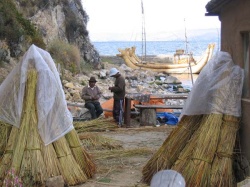
On the way back to Copacabana, the air had gotten colder and we could hear thunder in the distance. We stopped briefly at some ruins in the south, which had rather nice inset windows, and then headed back to Copacabana.
(written later)
There was a beautiful sunset over the lake. Then Rowshan and I had a nice dinner which included soup that was really hot (unlike the previous 2 meals we'd had)!
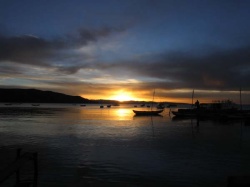
As we headed back to the hotel, we heard music from the sports center in the middle of the square. We squeezed into the crowded doorway and could barely see some brightly costumed dancers. It was part of an all day physical education festival. We managed to go up to the balcony and see the final dance. It was energetic and involved the dancers hitting their sandals on the floor.
That night, Copacabana decided to prove me wrong by becoming extremely loud. After the dance and physical fitness demonstrations were over, the town resounded with the sounds of brass band music. Then a DJ took over and played dance music into the night.
WE MADE IT TO BOLIVIA!!!!
27 November, 2007, 05:59 pm in "Bolivia"
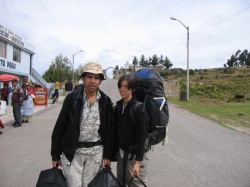 It has been a long travel day involving a sleepless overnight bus ride. Yesterday we left Ollantaytambo in the morning via shared taxi to Cusco. Not too eventful.
 We stashed our bags at South American Explorers and went to the bus station to buy our tickets to Bolivia on Litoral, the only bus that went direct from Cusco to Copacabana. The sales guy showed us photos of the bus and said there was a toilet on board and that it was a direct trip to Copacabana. The bus left at 10PM so we had the day to kill. We ran some errands, had lunch and hung out at the Buen Pastor. Rowshan bought a couple ceramics samples and we went on a mad search for bubble wrap. I considered buying a book but in the end just exchanged our Lonely Planet Peru for a book called Savages about the Huarani people in Ecuador trying to save their land (and way of life) from being destroyed by oil companies.
Towards the evening we did some research at SAE and then took our bags to Aldea Yanapay, a cafe I like which has lots of toys and games. We had dinner, played a game, had dessert, and otherwise amused ourselves until we ha to go to the bus terminal.
The bus seemed almost completely full of foreigners. As we were waiting, the 2 people in the seats across from us said they had just checked and the bus did not have a toilet.
The bus left about half an hour late (not unusual). As one of the drivers did the security video, Rowshan said "Donde esta el banyo?" to the camera. The guy responded, "Just tell us if you need one and we'll stop... so it is just like having one on board."
In the middle of the night, I requested a bathroom break. The driver said, "10 minutes". I looked out the window at the dark stretch of highway ahead and wondered what the stop would be... perhaps an outcropping of rock, or a sign that would shield me from the occasional car passing by. It turned out to be a very closed looking gas station. I walked alone across the street to the dark building and was relieved to find the bathroom was unlocked and there was a light switch. Lots of other people began filing in. Returning to the bus, all the lights were on so anyone who had managed to sleep had to wake up. After a few more minutes, the driver honked the horn and we were on our way again.
The bus was freezing but fortunately they had passed out blankets. After an uncomfortable night, I was relieved to see the sky begin to lighten. We were somewhere near Lake Titicaca. The area was kind of baren and I could see glimpses of the lake. Bright pink flamingoes were standing by the shore. We drove through Puno and then towards the border. At a fork in the road, a woman asked if the people going to Copacabana would please get off and take a combi. I thought she was just a passenger who wanted to go by combi instead of bus and was trying to get enough people together to fill a combi. We stayed where we were. After all, the bus was direct so why pay for a combi. It turned out she was actually a representative of the bus company. The bus did not go to Copacabana. "Direct" meant that when the road forked, all the passangers going to Copacabana got to get their bags and cram into a combi. There were about 12 passengers, all gringos and all a bit unclear about what was going on. The combi driver, of course, crammed a few more people in the van to make sure we felt like sardines and then drove us about 10 minutes to the border. We changed money, were able to use a toilet, then picked up our bags and walked through the border. The Bolivian border guard gave us 30 days. When I asked for 90 he said that since the new visa law was going into effect on Dec. 1, US citizens could only get 30 days, and would have to apply for a visa (and pay $135) for more.
After we got through the border, we boarded another minivan which took us to Copacabana.
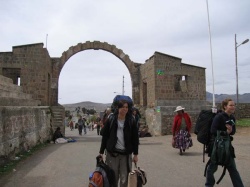
As we boarded the minivan, Rowshan pointed out a woman with a bandage over one of her eyes. He said he'd seen about 10 people with bandaged eyes and wondered if it had to do with the meteorite that hit a couple months ago. I said this couldn't be since the meteorite hit Peru and the problems associated with it were flu like symptoms. Later in town, after seeing another person with a bandaged eye, Rowshan asked someone who responded that there were Cuban doctors in town doing free cataract surgeries so lots of people were coming over from Peru for eye operations.
Copacabana is an extremely quiet and sleepy town.
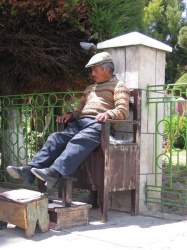
We checked into a hotel on one of the main squares because in spite of the combis and busses, it was surrealistically quiet. Ollantaytambo was smaller but had such a steady stream of tour busses and public transportation, as well as the rushing water, that there were always sounds.
There are a couple streets with restaurants and stores but mostly the streets seem empty of cars. There were usually just a few children playing in the street and a few dogs running around. We had a blah 9 boliviano set lunch (about $1.25), then walked down to the waterfront. The beach was covered with brightly painted swan boats (and one pelican boat and a couple duck boats).
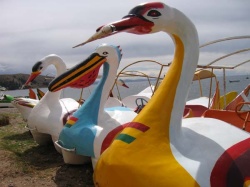
There weren't many people around. The sun was warm but there was a cool breeze. We walked up the beach and back. Even though it is getting to be summer, the beach felt like a holiday resort off season.
Copacabana has a lot of hotels, brightly painted and sometimes with colonial decor, frills or other ornate trim. Most of the people on the streets seem to be foreigners. We walked to the cathedral. It is an interesting building with colored tiles on the roof.
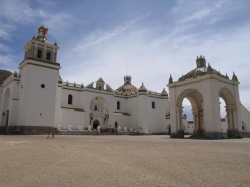
The architecture seems lighter than the heavy serious Spanish cathedrals we'd seen around Peru. The town afeels lighter, too with its brightly painted hotels.
Powered by My Blog 1.69. Copyright 2003-2006 FuzzyMonkey.net.
Created by the scripting wizards at FuzzyMonkey.net..
(Code modified by Rowshan Dowlatabadi)
Created by the scripting wizards at FuzzyMonkey.net..
(Code modified by Rowshan Dowlatabadi)