

Making Ceramics in Ollantaytambo
26 November, 2007, 05:59 pm in "Peru"
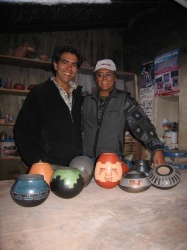 While we were in Ollantaytambo in November, we visited the Catcco musum and Lucho Soler's workshop. Lucho lived in Santa Fe (New Mexico) for 20 years. His goal for his students is to create very fine pottery and make new artists as well as making Ollantaytambo known as the place where the best Peruvian pottery is made. Also, he wants to raise the quality of Peruvian pottery to the same level as achieved by their ancestors.
When I asked about studying ceramics with him, he said that we could do classes for two or three weeks. I started the class on November 12th.
Lucho and all of his students make their pots manually, same as Pueblo people in New Mexico. There was also a kickwheel. My plan was to make a few pieces using the wheel and also manually. The first week, I made 8 pots using the wheel.
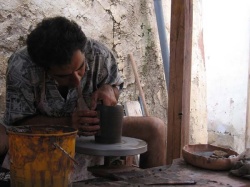
Because it is difficult to buy clay in the area, most of the artists make their own clay. Lucho finds his clay around Cusco. I was always wondering about making my own clay and this was a great opportunity to learn the process. Lucho gave me the raw clay and sand and showed me what needs to be done. Making clay was a long and fun process which took 4 days.
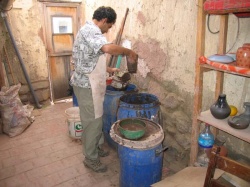
This way my own clay was ready for the second week when I did three pots manually.
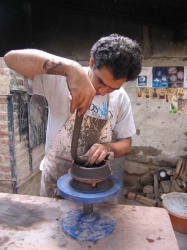
I used a river stone to burnish the pots both before/after glazing. Burnishing is very important part of this art if you want to have good looking results. Also it is tricky and needs to be done at the right time and diligently. Basically, the more the pot is burnished, the shinnier it will become.
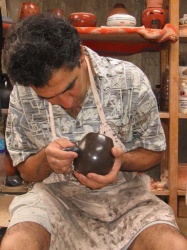
I used three colors (green, blue and red oxide) in a few of the pots. I finished all the design (carving, glazing) in the second week.
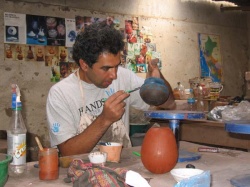
Since some of the pots were still wet, I put them outside under the sun to dry them.
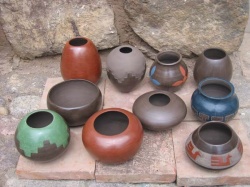
However, the weather was changged from sunny to rainy soon after about two hours sitting outside guarding the pots. Lucho decided to dry them in electric kiln for about 2 hours and then fired them for three hours. The color of the pots at this time was earthy.
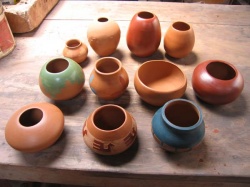
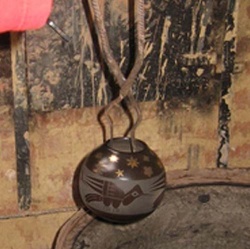
The next step was to process the pots with smoke to make them black. In Chulucanas, potters use special slip to cover the parts that they don't want to be black and smoke the pots. I also prepared my own slip and covered the glazed parts (colored parts). The smoking process is very interesting. Lucho has made a special kiln for that. The pots were warmed up for about an hour and then cow manure was used in a tray above the pots which caused a lack of oxygen which as a result made the pots black. Here are before and after pictures of smoking.
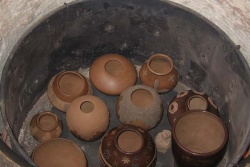
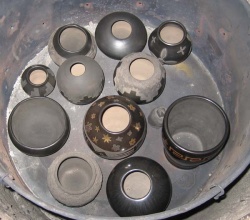
This kind of pottery was always in my mind when I first saw the pots of New Mexico. I am so glad that I learned a lot about the complete process: from making the clay to burnishing/carving/smoking the pots.
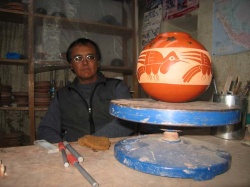
Lucho is a very talented and experienced artist. Here is one of his works of art before and during smoking process when he was taking the piece out.
Visiting Rumira
20 November, 2007, 03:46 pm in "Peru"
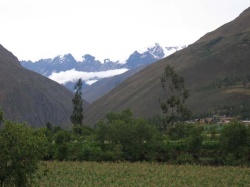 Michelle, a volunteer who is writing the content for the Living Heart website as well as working on fundraising, and I were supposed to meet with the Living Heart project manager at the cafe at 8 to go visit the school in Rumira, one of the communities where Living Heart has projects. The project manager didn't show up so Sonia, assuming she had gone directly to the school, stuck us in a motor-taxi and sent us down the road. It wasn't very far... just about 10 minutes up the street from Ollantaytambo in a picturesque location in the valley.
 We walked into the school yard and approached a woman standing in front of a classroom. I asked if the project manager was there and we were told she hadn't arrived yet. Then the woman asked "Are you hear to work with the children." I said "yes," thinking that since we were with the organization, that was the appropriate answer. She led us to a classroom with about 15 students, explained the teacher was sick, and then started to leave. A bit confused, I said, "We aren't teachers!" She just turned and said, "Play with them." Then she rushed out of the classroom and dissapeared. Michelle and I looked at each other nervously. Michelle spoke less Spanish than I did and neither of us had expected we'd have to entertain children. We introduced ourselves and were met by a bunch of expectant faces. Struggling for some activity, I asked them to sing a song. Since that didn't get much of a response, I searched the room for inspiration and noticed a poster of a body with the words in English and Spanish. "Do you know Head and Shoulders Knees and Toes?" I asked Michelle. "Yes, but I'm not going to sing it by myself!" she replied. So I asked the kids if they'd like to learn an English song. Fortunately, they said yes so we taught them "Head and Shoulders." They seemed to enjoy it and several said they knew it in Spanish. So we had them teach us "Cabeza Kara Hombros Pieds" (Head, Face, Shoulders, Legs). Then several said they could sing it in Quechua but the response was kind of scattered so we figured we should move on. We killed some time with numbers and then I asked them to tell me about the names of famous Peruvians hanging from the ceiling. Fortunatly, at that moment the project manager walked in and began cutting up cardboard, explaining the kids were going to make puppets to use when the drama teacher, another volunteer, arrived. A few minutes later, the drama teacher arrived and quickly took over the class. Michelle and I, much relieved, were able to sink into the easy roles of observers. We went out and looked at the garden that had been started using plants and seeds provided by Living Heart.
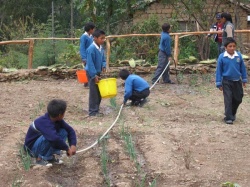
Then we went back to the drama class. The puppets were ready and the teacher had a group of students put on a show for their classmates. After the puppet show, they played a game where the boys had to say what they hated about girls and vice vers. Responses were that girls were short and drank chicha while boys were drunks. Then they had to say good things which were the girls cooked, washed clothes and cleaned while the boys were romantic, worked in the fields and brought home money. Then they did some improv activities and played an animal game where they acted out different animals, ending with a group impersonation of King Kong.
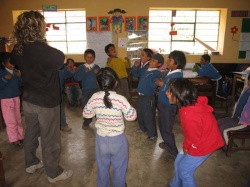
The kids had a break for a snack of hot cereal, milk and bread. Toward the end of the break, Michelle and I started playing ball with some of the kids. The teacher who had drafted us before jumped on the opportunity again asking, "Do you want to play with the kids?" We said, "Sure," and soon the entire class was sent running down and scattering around the playing field. The girls sat on the bleachers and a couple of the boys started playing with the ball which soon went over the bleachers and into a bush. As I went to find it, I heard a comotion as the students all rushed to one side of the field. I saw them looking at something in the grass and throwing rocks at it. Thinking it was a bug, I continued searching for the ball. Then one of the boys excitedly told me they had found a snake. "Is it dangerous?" I asked. "YES!" he said. I imagined trying to explain to the teacher that a student had been bitten by a poisonous snake while we were supposedly playing ball with them. At that moment the teacher appeared and suggested that we watch the drama teacher's class with the little kids. "We've been fired." I told Michelle.
The little kids were completely enjoying a puppet presentation of the Three Little Pigs. There was lots of audience participation required, including singing a song for the pigs to dance to. After the class, Michelle and I walked back to town.
11-26
I managed to finish the Living Heart Web site which is up and online at
www.livingheartperu.org. I also got the updates for www.heartscafe.org up. Check them out if you are interested in reading about some neat projects to help women and children in the Sacred Valley, Peru.
[ View 1 Comments
|
]
Pumamarca and Moray
19 November, 2007, 03:46 pm in "Peru"
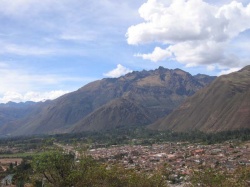
I took the weekend off and Rowshan and I went hiking down a road with a sign that said, "Pumamarca". The road ran along a river with mountains rising up on both sides. At one point it forked over a bridge. We took the smaller road which started going up the side of a mountain and providing us with views of the green fields and livestock. Rowshan turned back to go work on ceramics, but I climbed for a half hour more which had its reward--a view of some nice ruins above. I headed back before I got to the ruins since I told Rowshan I'd only hike for an hour more and then turn back and the ruins were still a ways off.
Note: Later in the week, Rowshan went back up the trail and climbed all the way up to the ruins. Rowshan said that the hike was so nice and peacefull especialy from the top of the ruins looking at the surronding fields and mountains.
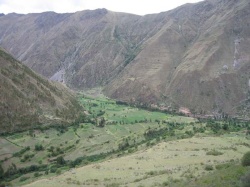
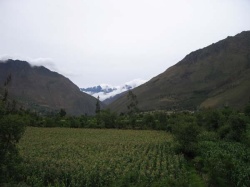
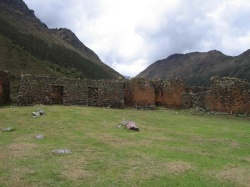
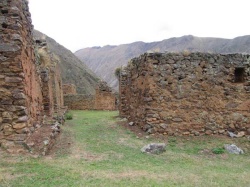
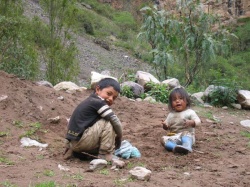
Rowshan also saw two kids playing with muds.
The people I met on the road all seemed really friendly, smiling and saying, "Buen Dia". Back along the main road, it was a peaceful walk with the lulling sounds of the river. At one point the road goes by an extensive array of Incan terraces. At other points, part of the river is redirected into stone channels--maybe for irrigation or maybe it is actually the towns water supply.
Today we hopped the bus to the ruins at Moray. Well it wasn't actually that simple. First we hopped a combi to Urabamba. Then we boarded the bus to Chinchero which let us off at the turn off to Maras and Moray. There were 2 other travelers so we decided to share a taxi. We were all originally considering walking but since none of us knew the path, we figured a cab would be the best option. Then we could walk back or walk from Moray to Salinas and then to Urabamba.
Our taxi driver had other plans, saying for 30 soles he'd drive us there and back and wait an hour while we explored the ruins. We explained that we were thinking of walking back but he said it was a long way and pulled out a hand drawn map of the area to demonstrate how far everything was. At that moment I realized we were dealing with an expert, complete with visual aids. We told him we'd decide when we got there. I was looking for signs of a direct path through the fields but didn't see any. It was about 9 km from the village of Maras to the ruins. At the gate, he informed us of the price for the tickets (which was written clearly on a big board), greeted the guard by name, and we got out of the cab and started debating. The taxi driver pointed to a huge patch of rain in the valley "Lluvia!" he said excitedly, hoping this would pursuade us. When asked about the path to Salinas, he said there was none. I guessed that asking the guard wouldn't get any better result. Finally we agreed to take his cab back to the highway. Happily he gestured for us to follow as he walked 20ft to an overlook where we could see the ruins. He reminded me for a moment of good Golem in the Two Towers when he defeats the evil Golem and happily leads Sam and Frodo toward Mordor. We were all kind of feeling like Sam.
Moray is a series of agricultural terraces. However, instead of the usual Incan terraces that follow the curve of the mountainsides, these are set in bowl shaped indentations in the earth making huge circular (or oval) ampitheatre formations.
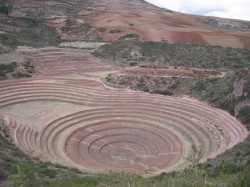
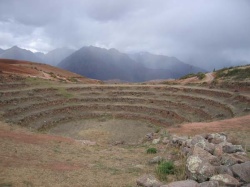
It is guessed that they were a type of agricultural lab for the Incans because the arrangement created microclimates. Sure enough, I could feel a noticable temperature change as we descended into the smallest one. One of the guys we were with said, "They should have concerts here." At one end of each ring there were large stones with a groove down the middle--perhaps for irrigation. As we got to the bottom of the largest set of rings, we realized there were some really cool acoustic qualities. We could hear people talking on the top ledge even though we couldn't see them. A mooing cow, high above us could also be heard clearly. In the center there was a crisp but deep echo. Then we climbed up rock steps out of the terraces. We asked the cab driver how much he'd charge us to take us to Urubamba. He replied 30 soles, a ridiculous amount considering taking the bus was only 1. He then set about trying to pursuade us to go visit Salinas for 30 soles more. Stopping the car, he turned to us and launched into a vivid description of all the beautiful salt pans and how when the salt was washed with warm water and you tasted it (he demonstrated touching an imaginary salt pan and then putting his finger on his tongue), it was wonderful (he looked toward the heavens and smiled in ecstacy). To his disapointment, we asked him to simply drop us off at the highway. Then we all caught the bus back to Urubamba.
Note: Later in the week, Rowshan went back up the trail and climbed all the way up to the ruins. Rowshan said that the hike was so nice and peacefull especialy from the top of the ruins looking at the surronding fields and mountains.
Rowshan also saw two kids playing with muds.
The people I met on the road all seemed really friendly, smiling and saying, "Buen Dia". Back along the main road, it was a peaceful walk with the lulling sounds of the river. At one point the road goes by an extensive array of Incan terraces. At other points, part of the river is redirected into stone channels--maybe for irrigation or maybe it is actually the towns water supply.
Today we hopped the bus to the ruins at Moray. Well it wasn't actually that simple. First we hopped a combi to Urabamba. Then we boarded the bus to Chinchero which let us off at the turn off to Maras and Moray. There were 2 other travelers so we decided to share a taxi. We were all originally considering walking but since none of us knew the path, we figured a cab would be the best option. Then we could walk back or walk from Moray to Salinas and then to Urabamba.
Our taxi driver had other plans, saying for 30 soles he'd drive us there and back and wait an hour while we explored the ruins. We explained that we were thinking of walking back but he said it was a long way and pulled out a hand drawn map of the area to demonstrate how far everything was. At that moment I realized we were dealing with an expert, complete with visual aids. We told him we'd decide when we got there. I was looking for signs of a direct path through the fields but didn't see any. It was about 9 km from the village of Maras to the ruins. At the gate, he informed us of the price for the tickets (which was written clearly on a big board), greeted the guard by name, and we got out of the cab and started debating. The taxi driver pointed to a huge patch of rain in the valley "Lluvia!" he said excitedly, hoping this would pursuade us. When asked about the path to Salinas, he said there was none. I guessed that asking the guard wouldn't get any better result. Finally we agreed to take his cab back to the highway. Happily he gestured for us to follow as he walked 20ft to an overlook where we could see the ruins. He reminded me for a moment of good Golem in the Two Towers when he defeats the evil Golem and happily leads Sam and Frodo toward Mordor. We were all kind of feeling like Sam.
Moray is a series of agricultural terraces. However, instead of the usual Incan terraces that follow the curve of the mountainsides, these are set in bowl shaped indentations in the earth making huge circular (or oval) ampitheatre formations.
It is guessed that they were a type of agricultural lab for the Incans because the arrangement created microclimates. Sure enough, I could feel a noticable temperature change as we descended into the smallest one. One of the guys we were with said, "They should have concerts here." At one end of each ring there were large stones with a groove down the middle--perhaps for irrigation. As we got to the bottom of the largest set of rings, we realized there were some really cool acoustic qualities. We could hear people talking on the top ledge even though we couldn't see them. A mooing cow, high above us could also be heard clearly. In the center there was a crisp but deep echo. Then we climbed up rock steps out of the terraces. We asked the cab driver how much he'd charge us to take us to Urubamba. He replied 30 soles, a ridiculous amount considering taking the bus was only 1. He then set about trying to pursuade us to go visit Salinas for 30 soles more. Stopping the car, he turned to us and launched into a vivid description of all the beautiful salt pans and how when the salt was washed with warm water and you tasted it (he demonstrated touching an imaginary salt pan and then putting his finger on his tongue), it was wonderful (he looked toward the heavens and smiled in ecstacy). To his disapointment, we asked him to simply drop us off at the highway. Then we all caught the bus back to Urubamba.
Powered by My Blog 1.69. Copyright 2003-2006 FuzzyMonkey.net.
Created by the scripting wizards at FuzzyMonkey.net..
(Code modified by Rowshan Dowlatabadi)
Created by the scripting wizards at FuzzyMonkey.net..
(Code modified by Rowshan Dowlatabadi)