

Tamia Finds Something to Do in Ollantaytambo
16 November, 2007, 03:46 pm in "Peru"
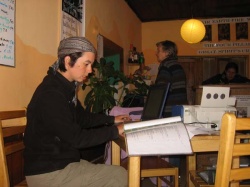 On Wednesday I met Sonia of Hearts Cafe. I had been looking for something to do for the 2 weeks Rowshan would be taking class. On Tuesday I talked to some people from the museum but I just didn't get the feeling that my skills would be any use. They have a program where volunteers pay $150 a week for lodging and the privilage of volunteering. When I said I didn't want to pay the fee but was willing to volunteer, they told me I could work in their store selling textiles made by women from some of the communities in the mountains. Yes, it is a nice thing that they are doing, selling textiles for the women in the communities, but it just seems that if they are going to realistically run a business, they need to run it well enough that they could hire people from the community to work in the shop (and get a fair wage) and not rely on volunteers. I guess, I'm becoming fussy about volunteering... But, if I'm going to put my time into something, I want it to be for something I believe in and where my skills are actually worth something.
 So, I went into Hearts Cafe and talked to Sonia. Sonia is amazing. She is running the cafe, dealing with immigration issues and changes in policy about businesses run by foreigners, she has just started an NGO, Living Heart, and she has a bunch of different humanitarian projects she is juggling. All this at an age where many people would think of retiring to a nice beach town and playing golf. Hearts Cafe exists to raise funds for projects that help women and children in villages in the Sacred Valley. While doing this, it also employs people from the community, pays them a decent wage, and provides tourists with perhaps the most nutritious food in Peru. As Sonia started to tell me about the cafe and the projects, she became more and more enthusiastic as she described the solutions they were providing for various problems faced by the communities she worked with. The projects include providing breakfasts for schools, contraception and family planning advice for women who want it, clothing distribution, donations of art and school supplies to schools as well as plants and seeds for organic gardens in the village. Living Heart also has organized doctor visits to villages and conservation projects.
Anyway, Sonia was delighted to learn I was a graphic/web designer. She needed to alter the logos for Hearts Cafe and Living Heart to have a shadow of the names translated into Spanish, the Cafe web page needed to be updated, and she needed a web page designed for Living Heart. Next week, someone would be coming to help with fundraising and writing the content. After talking to Sonia, she said I could think about what she needed and if I was interested, I could come in the next morning.
It was an easy decision. Something about Sonia and her projects just inspires people to want to help out.
The next morning, I met with Sonia at the cafe and got the full information about the projects, as well as started on the logos.
Ollantaytambo
13 November, 2007, 04:26 pm in "Peru"
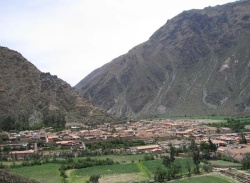 We are currently in Ollantaytambo, a very small and picturesque town of cobblestone streets and rock walls, nestled in a valley surrounded by tall mountains. The Urubamba river is at one side and a smaller river rushes through the town to join it. As if 2 rivers weren't enough, there are stone channels throughout the town guiding flowing water past the houses.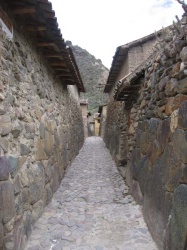
Sometimes the channels guide the water under the stone streets, then the channel surfaces somewhere else. I wonder if these are part of the Incan system used to flood the town when the Spanish invaded.
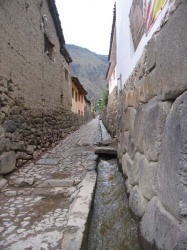
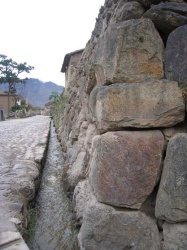
The main ruins cover the side of a mountain at one end of town, but the hills on the other side of town are also crowned with ruins and Incan terracing can be seen across the river. There is a small Plaza de Armas ringed with restaurants and antoerh plaza below the main ruins full of handicraft stands. There is a small mercado and a few mini-marts, but most of the businesses are tourist related: hostels, restaurants, souvenirs. We are going to be here for about 2 weeks. Rowshan is studying ceramics with Lucho Soler, a ceramic artist in residence at the CATCO Museum in town. Soler is Peruvian but lived in New Mexico for 20 years where he learned about Native American ceramic techniques. In Peru he studied and made museum quality reproductions of ancient Peruvian ceramics. His goal is to increase the quality of contemporary Peruvian ceramics through revival of ancient techniques mixed with contemporary standards of quality (i.e. using glazes instead of paint, etc.) He hopes that Peru can one day be a center for contemporary ceramic arts.
Rowshan came here on Monday, found a hostel (which was actually part of a traveler's clinic) and started classes. I spent another day and a half in Cusco, finishing my Spanish classes and then arrived here Tuesday afternoon for Rowshan's birthday. Unfortunately, I very quickly discovered that Ollantaytambo doesn't have any place where you can buy a cake. It doesn't even have a bakery for bread (you have to buy it from the back of cars or from women who sit in front of the mini-marts with big baskets of it). Eventually, after considering making an attempt to create a cake like creation from packaged cookies and caramel sauce, I found a paneton (christmas fruit bread), which seemed a wiser option. We celebrated Rowshan's birthday with the doctor on call and the ambulance driver from the clinic/hostel.
Homestay in Amaru (Pisac)
12 November, 2007, 04:12 pm in "Peru"
 I had found a brochure for the "Andean Homestay Program" at the South American Explorers office. It offered visitors a chance to "visit a small Quechua community, learn about their culture and traditions and stay in the homes of local people." So, Saturday afternoon, we showed up at the Peru Treks office where a porter, just back from the Inca Trail, met us and helped us get to Amaru. From the bus stop in Pisac, we walked to a combi stop and boarded a combi. The ruins of Pisac were visible high above the town and I was glad we'd be walking down from Amaru to see them instead of up from the town. After waiting for a bit, listening to the incomprehensible (for us) banter in Quechua going on around us, the combi started up, only to drive back the way we'd walked. It stopped and our guide, Victorino, leapt out and ran down the street, just as it started to move again. A man outside said something to us about getting out and taking a taxi. The combi turned around again and this time the man gestured for us to get out. I still didn't see Victorino so I told the guy that his backpack was on the roof of the combi. The guy pulled it off. Fortunately, at that moment, Victorino came running back and 8 of us crammed into a taxi, 3 in the back cargo area with several bags.
It turns out that there had been a discussion in Quechua about how the combi wasn't direct to Amaru and there were enough of us to share a taxi and go direct instead. Off we went up the mountains. Once past the ruins, the road forked and we took the fork that wasn't paved.
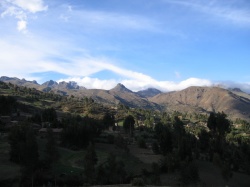
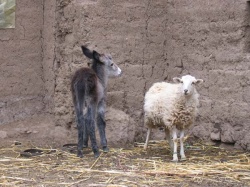
A bit later we arrived in the community of Amaru, high in the mountains (3800 meters). It was a beautiful spot with adobe houses, sloped fields and donkeys, sheep, pigs, chickens and cows wandering around. From the community, we could look down into the valley far below and up to the tops of the mountains, which seemed very close. The air was fresh and clean (sigh...she writes breathing the smokey air of an internet cafe...) and there was a cold wind. Victorino took us to the first house. There was a mother and baby donkey outside.
Inside the courtyard was an adobe house with "Hostel" and pictures painted in bright colors on it. This was the house of Adrian and Rosalina. We set our bags on a bench and were told to wait. A bit later, Adrian returned with another man wearing a brightly colored poncho and hat. He was carrying another poncho and hat which he put on Rowshan. This was Valentine who we would be staying with. A few minutes later, his wife showed up carrying a hat, skirt and woven shawl for me to wear. She put the skirt on over my pants and tied the band tight. Then she wrapped the woven shawl around my shoulders and pinned it.
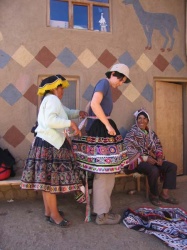
The hat was flat and barely held on by a beaded band. Then Valentine took us to his house. We had a little bit of time to leave our stuff in the room. Then V took us for a walk around the community, showing us his fields of different vegetables, a nice view point and the other features of the area: some ruins of old houses, the school, the soccer field... The wind was strong and my hat kept blowing off. I also found it hard moving in the skirt and shawl.
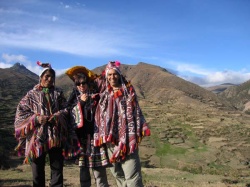
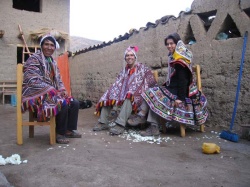
Back at the house, the horses were just being brought in for the night and being tied in a feeding area with the cows. There was a calf and a foal. V explained that it was hard for the animals to find grass right now because the rains hadn't started so everything was dry.
As we sat waiting for dinner, V's little girls showered us with rose petals.
Dinner was popped corn, different from the popcorn in the US in that the huge kernals did not pop into popcorn flowers but rather just popped inside the kernals. We also had delicious thick Quinoa soup with all the ingredients coming from V's fields. We ate dinner at a table in a room that doubled as a store.
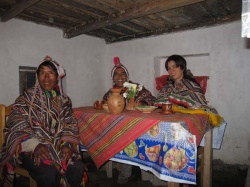
Every now and then, a neighbor would pop in to buy something. We talked a bit and V explained that he had knitted the hats that he and Rowshan were wearing himself.
After dinner there was supposed to be music and dancing at Adrian's house. We went over and sat in their kitchen. It was warmed by a fire and guinea pigs squeaked contentedly from their pen, and from a corner closer to the fire, where the babies and their mother lived. V was going to play his drum with a flute player, but the flute player didn't show up. We entertained for a while with the help of a Quechua phrase book. Everyone was amused by our butchering of their language. Then we headed back to the house and were in bed by 9.
The family woke up early and were busy taking care of the animals. We got up too, but just had to enjoy the morning. Breakfast consisted of a glass of oatmeal and delicious pancakes made with corn flour, onions, and a fresh egg from one of the 2 chickens that lived in the yard. After breakfast, V took us to Adrian's house where he needed to attend a short meeting. The meeting was in Quechua so we didn't understand, but it must have been about the homestay program since they distributed more brochures to everyone. 2 girls set up weaving samples to sell. We bought 2 belts to use to decorate R's accordion starps. Then V led us down a trail out of the community, explaining how it was a trail created by the Incas. V sped down it, reminding us that he had once worked as a porter. We followed. It took us about an hour and a half to get to the ruins. The brochure says it is about a 2 and a half hour walk. We spent some time looking at the ruins before heading down a steep path into town.
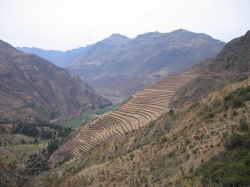
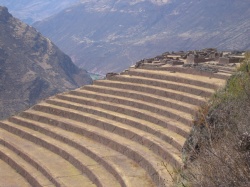
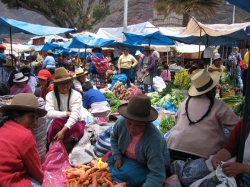
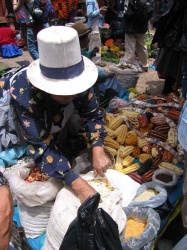
The path spit us out into the Sunday market. Mostly it was handicrafts, but at the edge were lots of people selling fragrant vegetables from their fields. Once in town, we bid farewell to our host and headed back to Cusco.
[ View 1 Comments
|
]
Powered by My Blog 1.69. Copyright 2003-2006 FuzzyMonkey.net.
Created by the scripting wizards at FuzzyMonkey.net..
(Code modified by Rowshan Dowlatabadi)
Created by the scripting wizards at FuzzyMonkey.net..
(Code modified by Rowshan Dowlatabadi)