

Aguas Calientes
27 October, 2007, 06:13 pm in "Peru"
 Much as I may complain about the outrageous prices, the privitazation, and monopolization of the railroad to Aguas Calientes, I have to admit it is a stunning trip.
The train ride out of Cusco is a bit long but provides nice views of the city...several times...since the train has to navigate several switchbacks which require it to back up over a section of track to catch the point where the tracks switch, travel for a while backwards and then repeat the process to go forward again.
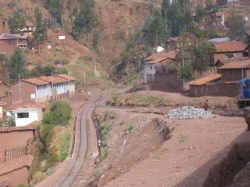
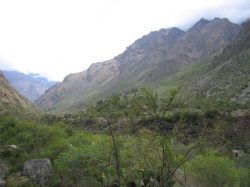
The train goes along a river that starts out just a small stream but grows into a full fledged river with white water and an occasional cascade. The valley is filled with farms and we saw lots of corn as well as a field of wheat (with a row of cows from the neighboring field with their heads stuck into the plants grazing). There were lots of sheep, donkeys and pigs.
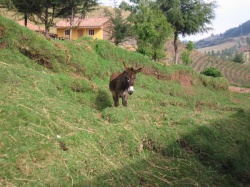
At one point the train had to screech to a halt as a cow decided to graze on the tracks. A worried farmer came running but the cow was fine and eventually meandered down joining the other cows in the next field. The mountains that create the valley are steep and sharp. Initially they were dry and we could see red rock like in Utah, beneath the dusty green fuzz of plant life.
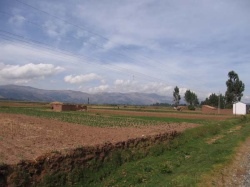
Sacred Valley
We got occasional glimpses of the glacier covered peak of Salkantay, as well as some other snow capped mountains. Nestled in the hills were occasional stone ruins.
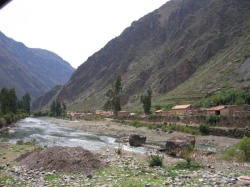
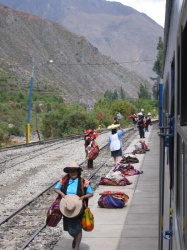
The train stopped in Ollantaytambo where the sellers were all around the train trying to make some money.
As we got closer to Aguas Calientes, the mountains got greener and more lush. High on the mountain cliffs, green bromeliad looking plants covered whole sections of the rock with gravity defying green spikey leaves.
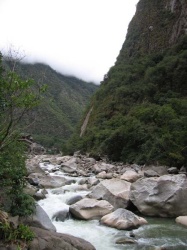
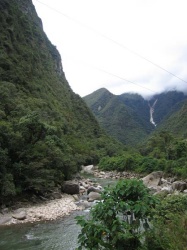
The train pulled into Aguas Calientes. The location is beautiful, with rushing rivers and steep cloud forest covered mountains. Unfortunately, the town is rather ugly. As we pulled into the station, I could see a dense mass of concrete block buildings glaring out from the beautiful forest. I think the only reason Aguas Calientes exists is to house, feed, and sell souvenirs to the hoards of tourists that pass through it going to Machu Picchu. It is a shame since the location is so beautiful.
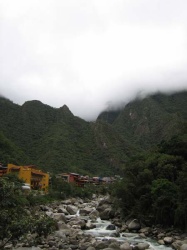
Rowshan and I, after a relatively expensive (but good for the area and tasty) meal at the Hare Krishna restaurant, we walked down the road toward Machu Picchu. We planned to get up really early the next day to beat the bus to the ruins so we wanted to get an idea of the distance. The afternoon clouds were settling on the mountain tops so we weren't sure we'd actually be able to see any sign of Machu Picchu. But the road was peaceful and the forest is beautiful and mysterious with the ghostly clouds drifting by.
I've decided I really love cloud forests. I guess that is what the rainforests in the mountains of the Pacific Northwest are even though they are very different from the Peruvian cloud forests. Both are lush, damp and green yet lack the heat of the jungle. Hidden by huge mountains, the cloud forests seem more mysterious and quiet than the hot boisterous jungles. There are birds but not the overwhelming cacophony of insects and bird sounds that we heard in the jungle. The rivers are cold and clean but the mountains dominate. The cascades and tropical flowers reminded me of Hawaii. The whole area seemed like similar in various ways to places I've been but at the same time completely strange and different.
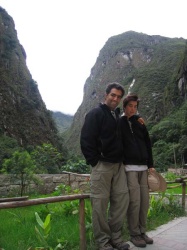
As we turned a corner, we noticed the clouds were higher and we could see the top of one of the mountains. Some of the gray stone walls of Machu Picchu were visible. It was a tantalizing vision: a mystical city high above us, which any minute could disappear behind the clouds.
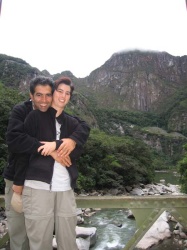
We decided to hike up the mountain across from it, Putucuse. The path ascended quickly on rock steps. At one point it provided a great view of the town attempting to burst out of the valley with its multipying buildings. Then we reached the ladder: a stretch of the path that went about 125 feet straight up a rock face on a sturdy wooden ladder.
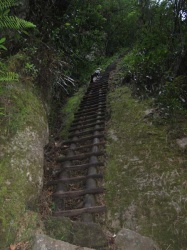
We headed up. As we reached what we thought was the top, we could see where another ladder climbed upward. I'm not sure how high it was because it started to pour. Climbing up when the wood was dry was one thing but we didn[t feel like braving the high ascent on slippery wooden ladder rungs. We headed back down. The clouds had moved lower so we wouldn't have been able to see much anyway.
Census Day and Rumiwasi
22 October, 2007, 05:13 pm in "Peru"
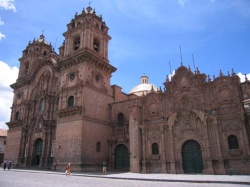
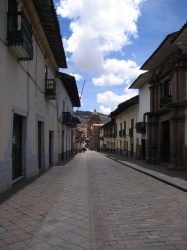 Yesterday was census day so all the Peruvians had to stay at home all day and be counted. Rowshan and I thought it would be a good time to walk around the center. There were barely any cars in the streets. We walked to the center. It was peaceful without the cars but by no means empty. It was possible to see exactly how many tourists there are in Cusco. In fact, the Plaza de Armas looked about the same, though it was a lot more pleasant without the touts and cars.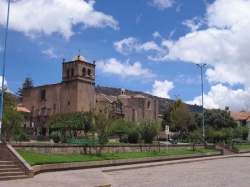
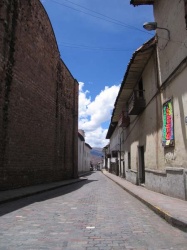
Since none of the restaurants were open, we headed back to the house for lunch. After that we played some music and let Armando (host dad) try out Rowshan's accordion and Manchi (host mom) try out my harp. Then Armando took us on a hike to see Rumi Wasi, a bunch of Incan ruins on the hill above the house.
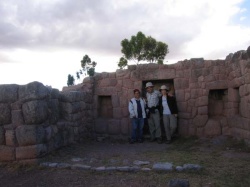
Armando has a field there above the ruins. The walk was very pleasant providing splendid views of Cusco.
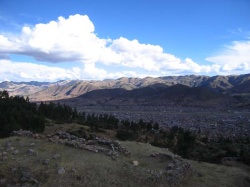
People were playing and picnicing in the ruins.
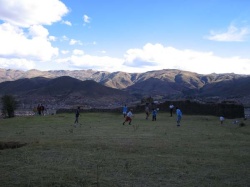
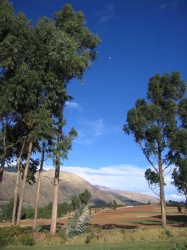
Rumi Wasi means "stone house". Armando also showed us a cave and several places where people had dug holes to take gold they found using metal detectors. Armando's field was in a picturesque place next to some eucalyptus trees. I told him I thought in 10 years he'd have some very valuable property since the city was growing so fast and eventually there'd be electricity and water brought up the hill and people would want houses with a view. Since his property was just above the ruins, no one could build in front of him.
Further up the hill was a small lake. While Armando talked business with a shepherd, Rowshan and I sat by the lake and talked to the shepherd's son. 2 little kids joined us.
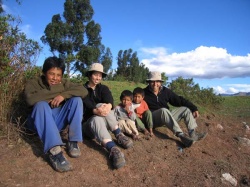
The hills above Cusco are so beautiful. They are peaceful and speckled with ruins. Apparently the Incans usually chose to live in the hills and have their fields in the valleys by the rivers. Now it was the other way around with the houses in the valleys and the fields in the hills. Off in the distance we could see the snow capped peaks of Ausangate, the highest mountain in the area.
San Blas
20 October, 2007, 02:13 pm in "Peru"
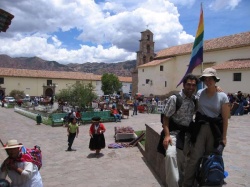 San Blas is known as the artists' area of Cusco. To get ther you walk up narrow cobblestone streets past handicraft stores, Incan walls and loads of tourist based businesses.
 The square is named for a church, of course, and is filled with handicraft sellers. There is a stage with a fountain in the back of it and 2 speakers were blasting, interestingly enough, the same CD we'd bought from Jose and Washington, our Peruvian musician friends we met in Istanbul 8 years ago.
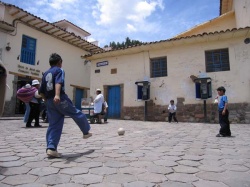
We had been inspecting potential housing options for when we have to leave our current homestay in November. San Blas has nice cafes, atmosphere and a view but it is a tad expensive. There were a few kids playing soccer using two pay telephones as goals next to the church.
Just off the square, we found an interesting gallery with intricately painted ceramics. Some of the pieces were huge plates entirely covered with detailed patters and designs based on traditional Incan patterns. Through a window we could see a man varnishing the pieces in the workshop.
Another gallery we found belonged to the sculptor Edilberto Merida Rodriguez. We walked in and a moment later the artist arrived and opened the gate into his gallery. The sculptures were mostly of the typical Peruvian ceramics subjects: traditional village life and religious scense with Peruvian characters.
However, the pieces were more contemporary in style. There was a roughness and raw emotion to them: strong workworn hands and faces screaming out in protest. My favorite piece was called Pueblas Protestas. It was a figure of a pregnant woman whose belly was split into prison bars. Peoples arms and faces were clawing and reaching up from her skirt. Merida explained it was showing protests in the villages against hunger.
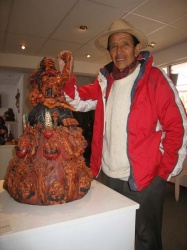
On the walls were various awards granted by various people including the president of Peru as well as honorary degrees. There was also a photo of him presenting a crucifix sculpture to Pope John Paul II.
Rowshan asked if he had a workshop but Merida replied he couldn't work anymore and gestured to his face. I'm not sure if he meant he was too sick to work or getting too old. Rowshan bought one of his sculptures for around $15.
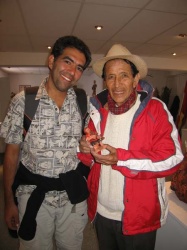
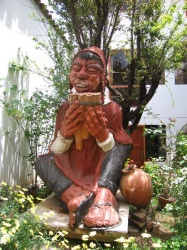
I thought it would be more. On the way out we passed a case full of clippings, most fairly old, with headlines like "Peruvian Picasso." In the courtyard was a huge clay statue of a boy playing panpipes. The walls were decorated with clay figures reaching up and out from clay panels.
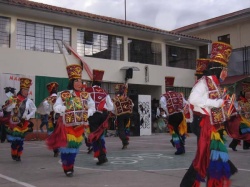
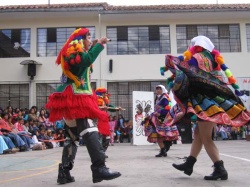
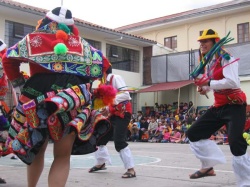
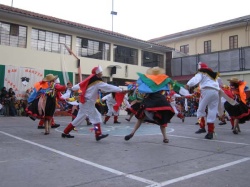
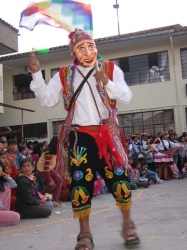
My practice teacher had invited us to a performance of music and dance at her daughter's school. The parents of each class had arranged a traditional dance or musical performance. Entrance was 15 cents.
The dancing was really impressive, especially considering most must have been amateurs. They had interesting choreographies, varied dances and great costumes, each group different. There were a few musical acts but mostly there were dance performances. The scene was a bit crazy. All the kids from whichever class was represented by the group of dancers performing would scream, throw confetti and light fire crackers.
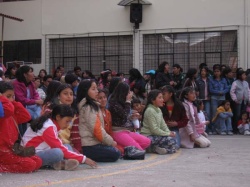
The performance was outside in the courtyard of the school which was also part of a convent. Around 5:30, it started pouring. The group dancing finished their dance, getting soaked in the process. A 20 minute weather break was called. Rowshan and I left because the rain didn't seem like it would let up for a while so we didn't get to see my teacher dance. Later I learned the remaining 10-15 dances were performed in the rain.
Powered by My Blog 1.69. Copyright 2003-2006 FuzzyMonkey.net.
Created by the scripting wizards at FuzzyMonkey.net..
(Code modified by Rowshan Dowlatabadi)
Created by the scripting wizards at FuzzyMonkey.net..
(Code modified by Rowshan Dowlatabadi)