

Qorikancha and Cusco
19 October, 2007, 01:45 pm in "Peru"
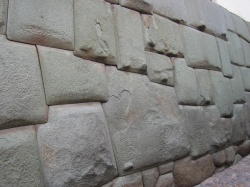
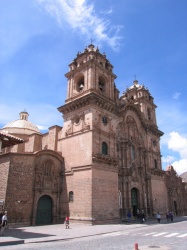 Since we have 6 hours of classes a day, we haven't had much time to sight see. However, today we went to Qorikancha with our practice teachers. Qorikancha was an important Incan temple which the Spanish built the Convent of Santo Domingo on top of. The first 10 feet of walls are Incan then the rest is Spanish. Parts of the Incan walls were knocked down to make the halls of the churches and Spanish colonial arches rise out of the huge Incan stone work. There are rooms of Spanish religious paintings and other rooms containing artwork about Incan cosmology and religious beliefs.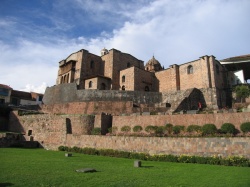
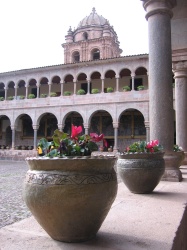
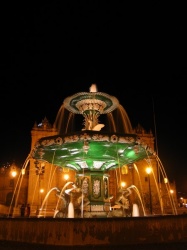
An Incan fountain stone is in the center surrounded by Spanish arches which are in front of Incan chambers. In the back are terraces filed with flowers and paths.
In the past few days I've learned a lot about Cusco my practice teacher. She's lived in Cusco for most of her life and told me how her father told her there used to be 2 crystal rivers and lots of wild vicunas. Now the city has grown, the rivers have shrunk and what's left has become poluted. She learned Quechua from her grandparents with whom she'd spend vacations with as a child. Her parents refused to teach her Quechua, a common occurance, leading to the diminishing of the language. However, most of the street names seem to be in Quechua around here and I think there is a growing effort to preserve it, as well as growing pride in being a Quechua speaker.
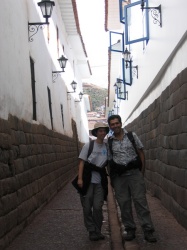
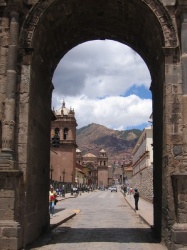
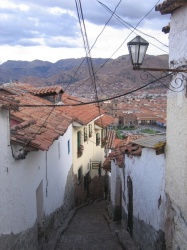
Cusco would look very European, if it didn't have all the Incan walls and Peruvian handcrafts. Narrow cobblestone streets lead up the hills and around the center.
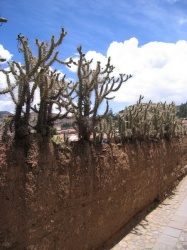
We really liked the use of cactus growing on adobe walls as a theft deterant.
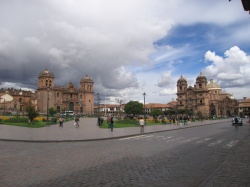
There are lots of buildings with doors leading to courtyards. The Plaza de Armas has cafes overlooking the plaza and swanky restaurants and shops selling fine clothing made from alpaca.
There are tons of tourists compared to the rest of Peru, even though it is off season. I'm glad we chose Cusco to learn Spanish in.
Spanish Lessons in Cusco
19 October, 2007, 02:49 am in "Peru"
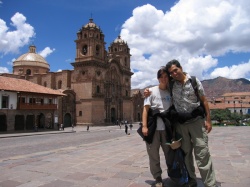
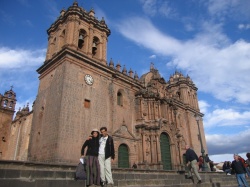 Cusco is beautiful. As as the plane approached it we could see bunches of red ti led roofs nestled between mountains. The center is full of old Spanish buildings, some built on top of strong Incan walls of huge straight edged blocks of cut stone. The city is growing and beginning to sprawl up the hills but the old parts have be en preserved very well.
 There are churches everywhere and their towers rise above the other buildings.
We are about an hours walk from the center (15 minute bus ride) at another home stay. This time, though, it is a larger house with 3 rooms that are rented out. The house is owned by the family of Fanny and John who started Fair Play. Fair Play is a neat organization that trains single mothers to teach Spanish. After they train them, they provide students and classroom space. Since the organization is non-profit, the teachers make 2-3 times more than if they worked in a regular Spanish school, and the working conditions are better. Strangely enough, the prices for classes are some of the cheapest I've seen in town and they are private. So far, I've been impressed by their teaching program (which says a lot because I'm picky about language classes). We have 2 hours of grammar in the morning and then 4 hours of practice which involves wandering around town with our teachers , talking, being corrected and sometimes stopping and really working on specific points. It can be exhausting but I think our Spanish is improving quickly. As I've talked to my 2 teachers, it is also great to learn how the program has helped them raise their standard of lif e and become self sufficient and able to provide for their children instead of being forced back into negative relationships.
Learning Ceramics in Lurin
16 October, 2007, 02:49 am in "Peru"
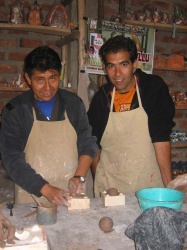 Ayacuchan ceramics are mostly inspired by aspects of daily life including people, animals, churches, musicians, traditional custumes, as well as religious scenes with Peruvian characters. Almost all of the ceramics are made by hand or mold. Very few artists use the wheel. If they do it is just for smoothing the surface of a round shaped piece.
To earn a living, the artists first make the original piece and then make molds from it for producing numerous copies. Of course, the amount depends on how hot the market is in Lima and other parts of the world. Mauralio mentioned that he also gets orders from Canada, Germany and Japan. Of course, most of the artists would prefer to spend more time making original large pieces but it is harder to find buyers for these.
On the first day we went to the workshop with Maurelio, he showed us how some of the pieces were made in molds and then how to sculpt a face. He made a ball of clay, a couple notches with a wooden tool (tallelor) for nose and eye sockets. Then with a few more quick moves, he shaped the features. Another couple notches became lips. A couple balls of clay were flattened and somehow delicately shaped into eyelids. He made it look incredibly easy and the whole process took him a couple minutes.
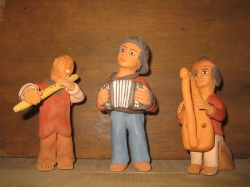
Then he showed me how to make the arms, legs, hands, fingers etc. I started using the faces that Mauralio had made and some of mine and made five musicians. Mauralio told me that the body part needs to be hollow which means that none of the pieces could be fired. He said that the next day we will continue.
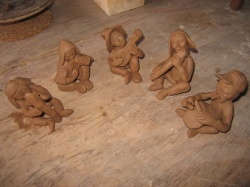
The next day he showed me how to make a ball and use it for the face and body part. Still it was so difficult to make a right face at my level. I started making the other parts. After a few hours, I managed to finish four pieces (Accordionist, flutist, harpist and guitarist). During the day Mauralio also showed me how to make molds of the original pieces.
On Friday Mauralio went to Lima for a special fair at the American Consulate. The pieces were still wet but dry enough for painting. An unfortunate thing happend while I was painting the accordion player. I broke it into three pieces while trying to clean a color from the hat. Carlos told me that the pieces can be glued together after firing. But, I didn't like the solution. I explained to him in my broken Spanish that the broken piece wont be the same. It was a difficult time because Mauralio had told me that he was going to fire all the pieces on Saturday. A day was not enough for any piece to dry especially during the cloudy days in Lurin. Therefor, I started making some experimental pieces using the molds. I wanted to test the stone burnishing process and then use mango leaves while firing in a manner similar to that used in Chulucanas. Lucho, Carlos and I had lots of fun that day. I believe that all of them had lots of fun when I tried to explain something in Spanish. Carlos showed me how to cut clay into rectangular slices. Then he showed me how to use the molds. I made three bowls that day. I made a few bowls and paited one of them using black glaze on black pot to experiment New Mexico style.
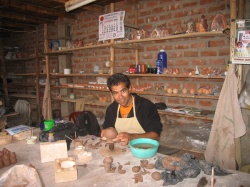
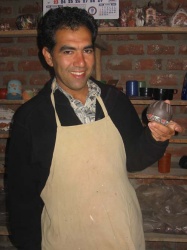
Mauralio has been working on some new molds for customers since we had arrived. I made a small accordion and showed it to Mauralio. He got my message and started making the face. I asked him if half a day would be enough for finishing everything. He said "si"!
Without loosing any time, I started making the arms, hands, feet and other parts. It was amazing that he did the face almost the same as the broken one! I was so happy about the progress. After attaching all the parts, he started a fire and told me that I need the sit there and change the pieces every 5 minutes so that they would be ready for the kiln firing.
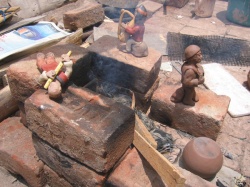
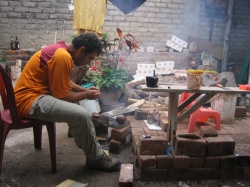
Later he came and took the pieces and put them into the kiln under a very light heat. After about an hour he took all the pieces out and I could paint the accordion player. He was going to start the fire that night at 7:00. The firing process took 7 hours under 800 degree celsius.
The first thing we did the next day was check the results. I was so happy since the pieces were fired properly.
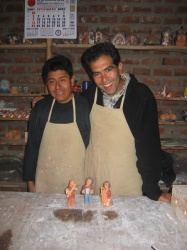
The only remaining part of my experience was my mango leaf firing. This was also new to them. Mauralio asked Lucho to take me to some place where there were mango trees. Lucho and I walked for about 40 minutes and found some trees that looked liked mangos but I was kind of suspicius. When I asked Lucho about it, he said "Yes, these trees are mango trees". We collected a full bag of "mango" leaves and went bak to the workshop. Mauralio saw the leaves and told us that the leaves were not the right ones!
Since I didn't have any time, I made a small kiln using bricks and started the fire. After about 15 minutes I stopped the fire since everywhere became full of smoke! The result was not bad at all. Some parts of the blue pot were changed to black. We came to the conclusion that the right leaf was necessary.
Powered by My Blog 1.69. Copyright 2003-2006 FuzzyMonkey.net.
Created by the scripting wizards at FuzzyMonkey.net..
(Code modified by Rowshan Dowlatabadi)
Created by the scripting wizards at FuzzyMonkey.net..
(Code modified by Rowshan Dowlatabadi)