

5 days in Lurin (10-15 October)
15 October, 2007, 02:15 pm in "Peru"
 Lurin is not a place you would imagine would house a artist community. Once you get past the ruins of Pachacamac you reach a stretch of chincharon restaurants, then a non-descript center of town with concrete and brick buildings. The minibuses stop at the mercado then continue past walls painted with political messages. The stop for the Ichimay Wari section of town, the Barrio Artisanos, has a big sign which seems to blend into the landscape. Fortunately there is a more obvious cross which serves as a landmark.
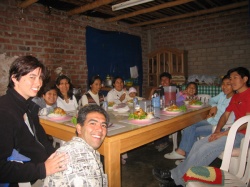
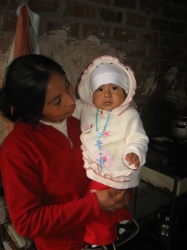
Lurin was our first experience with a home stay in Peru and it was wonderful. We were staying with Maurelio (the artist Rowshan was studying ceramics with) and his family: his wife, Hilda; sister-in-law, Janet; niece Roxanne; and daughters, Angi, Olga and Romina, the baby.
They are a wonderful family and incredibly nice people. They had recently finished the guest room. Janet and Hilda alternated cooking huge delicious meals. Everyone except Angi whose school was too far, ate lunch together and talked and laughed.
Rowshan and I communicated as best we could and Roxanne, who spoke some English helped. On the first day we went to the workshop with Maurelio, he showed us how some of the pieces were made in molds and then how to sculpt a face. He made a ball of clay, a couple notches with a wooden tool (tallelor) for nose and eye sockets. Then with a few more quick moves, he shaped the features. Another couple notches became lips. A couple balls of clay were flattened and somehow delicately shaped into eyelids. He made it look incredibly easy and the whole process took him a couple minutes. Rowshan and I tried and ended up with some rather disturbing looking results.
For the second day, I had the opportunity to paint with Dennis' host mom, Magdalena. She showed me how to paint leaves and flowers on eggs which had a big hole in the front where a creche scene would be placed. Magdalena painted quickly and easily. I found I had a talent for sticking my fingers on the part I'd just painted leaving smudgy fingerprints. Magdalena is married to Emelio, whose store we'd visited in Lima. His workshop is in the back of the house, an open yard with a place for a fire and freshly dyed yarn hanging in colorful rows from lines. In a covered area were several large wooden looms. Weavers quickly looped different yarns through to make the beautiful patterns that Emelio designed.
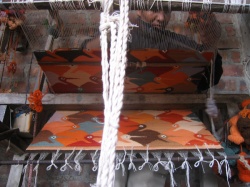
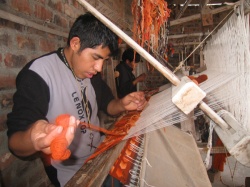
In Magdalena's workshop was a beautiful tapestry by Emilio, based on designs from the Paracas culture.
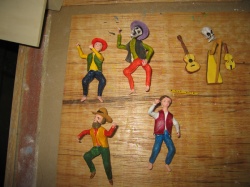
Day 3 was exciting for me because I was able to start studying retablo with Donato. Donato is a brilliant artist. His retablos are like none that I've seen. He arranges the figures and clothing like a choreographer positioning dancers and the figures look as if they would start moving the moment you turned your back.
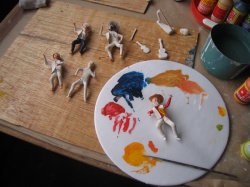
Donato had already prepared the dough and showed me how to knead it into gesso and shape the face in a mold. Then he shaped the neck and the rest of the body. I worked too slowly so the dough dried and cracked. The figures are small so it is delicate work. Donato would then bend the bodies and legs slightly, or tilt the neck a little giving the figures a feeling of motion. In the afternoon we added arms. We shaped them so they could be playing instruments. Donato was working on figures for a large mirror surrounded by wooden boxes, each of which held a scene. Behind me was another, further along, with figures with an initial layer of paint.
During a break we went to visit the ceramics workshop of Donato's brother. They were preparing bunches of trees of life along with Christmas decorations. Donato explained he started out learning ceramics then switched to retablo because it was more difficult. Clay wasn't fine enough to work in the detail required for retablo.
Evenings at the house were pleasant. Before dinner we'd talk, watch TV or (rarely) help with some of the food preparation. Rowshan impressed everyone, especially Olga, with his dishtowel into a chicken trick.
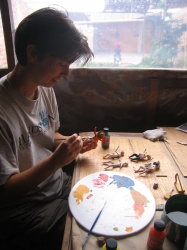
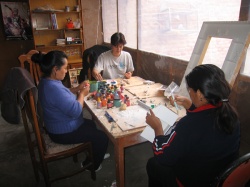
Day 4 I worked on instruments and arms in the morning and then made clothing in the afternoon. Teresa showed me how to paint the figurines.
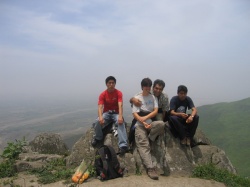
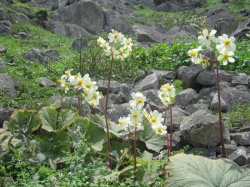
On Sunday morning, Maurelio took Rowshan, Lucho (who works in the workshop) and I hiking. There was an ecological park in a village near Pachacamac. It was beautiful. A path went up some mountains which, because of the location, were covered with green and flowers when everything else was brown. Birds sang and eagles circled. There were lots of big boulders with caves in them. The view was magnificent. It was about a 3 hour hike.
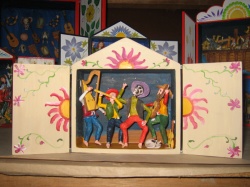
In the afternoon, I went to Donoto's workshop. His family was there, talking and listening to music. Teresa showed me some techniques for painting the box and then helped me glue the figurines into it. My retablo was complete. Donato approved of it and everyone was very complimentary.
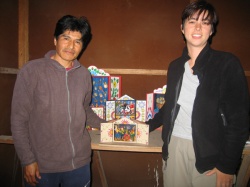
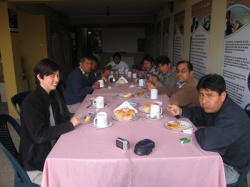
The last day we learned that several of the artists wanted to give us a farewell breakfast at the office.
We had tamales and looked at some of the art. Donato showed us a retablo he'd done based on the legend of the founding of Lurin. It was of course beautiful and neat because it was taking what was originally a Spanish art form and using it to tell the ancient myths of the region.
After breakfast we pulled out instruments. One of the artists played guitar. We jammed on some Peruvian songs. Then he taught us a popular Quechua song and another artist joined in on vocals.
Ichimay Wari Breakfast Music
Eventually everyone realized it was Monday and they needed to get some work done and we had to get to Lima.
Using every last moment, Maurelio showed us how to use liquid clay in a mold. Then we were offered "a little food" for lunch. This turned out to be a huge amount of food about 30 minutes after breakfast. Our last stop was Teofilo's workshop. Teofilo's specialty is clay masks which are very unique. He had lots of other interesting pieces as well.
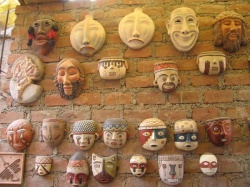
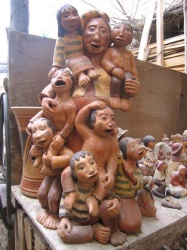
We then had to say goodbye to everyone and catch our taxi back to Lima.
Rowshan and I agree that this has been our best
experience in Peru so far--which says a lot since we
have really enjoyed almost everything about Peru. It was so wonderful to be around such friendly, welcoming and talented people. Even though we were there for a short time, we feel we've made some wonderful friends as well as learning a lot.
Walking through Shipibo Villages
7 October, 2007, 10:21 am in "Peru"
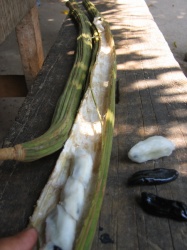
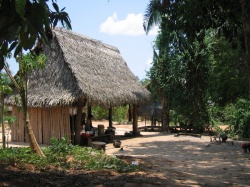 This morning we walked through Santa Clara, Santa Lucia and San Francisco. Our boat dropped us off and we walked to the community of Santa Clara. The houses are more traditional than in San Francisco: thatched roofs, thatched half walls and dirt floors and built high enough on hills so they wouldn't flood. At one house they were in the process of preparing new thatch. There were rows of sticks with the palm leaves carefully cut and bent in orderly rows. The leaves were green so they had to dry in the sun. A thatch would last about 10 years.
 Lalo showed us the pinon tree whose sap was good for curing ear infections as well as the dragon's blood tree, another useful tree whose sap is deep red and can cure ulcers, internal and external injuries. There is a factory in town which dries it and exports it to the US for use in pills.
At another house 2 women were making wind chimes using the thick heavy scales of a local fish and beads. We stopped and chatted for a while and tried an interesting fruit called a guava but nothing like the Hawaiian guavas my mother makes into jam. This guava was a long pod with furry seeds inside. The fruit was the furry skin which you peel off the seed and chew.
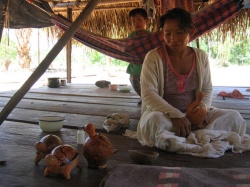
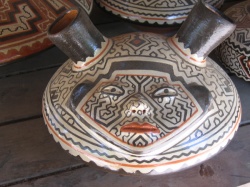
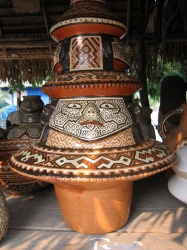
The next stop was a simple house with a fire pit in the yard. The house was a raised wood floor with a hammock, thatched roof, and partially thatched sides. A woman was busy painting bird and turtle shaped red banks with black Shipibo patterns. She showed us how she made the hollow figures by scraping a ball of clay into a hollow half sphere. There was a bucket of ash from a specific tree (Apacharama) which could be mixed with the clay. When we asked her about the Shipibo patterns she said she just learned them by watching people paint them. Since we couldn't buy anything, we paid her some sols for the demonstration. She tried to give us a bunch of necklaces and we had to explain we couldn't carry stuff and the money was for the lesson.
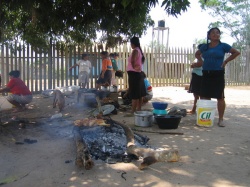
As we reached San Francisco, we were met by the smell of roasting chicken. Everyone was busy preparing food for the celebration. Everywhere there were fires with chicken roasting or big pots of rice covered with banana leaves. We saw Luis and said , "hi".
Our last stop was a house that had a lot of ceramic pieces. Rowshan got the ratio of ash to clay used and saw some of the pigments they used. They also explained how they made the pots shiny with the sap of a lacre tree. While the pots were still warm, they'd rub the block of hard sap over them which would melt, leaving a thin layer of lacquer.
We also got an interesting answer about the meaning of the lines in the Shipibo designs. The main potter said his grandfather had said the white represented mountains. When the Incas came to the rain forests they asked the Shipibo to teach them about pottery. Eventually, the black lines came to represent the rivers and Incan roads.
In the afternoon, our final activity of our stay at the lodge was a dreaded visit to a zoo. I'd been hoping to avoid the zoo fearing a depressing series of tiny cages with bedraggled animals.
It turned out it was actually an animal breeding facility. Most of the animals were reptiles and although it is of course better for them to be in the wild, they didn't seem too bothered by being in captivity (they were breeding). Instead of rows of cages, the zoo was a large grassy area with a few big trees enclosed by a tall fence. There were some birds wandering around including a silly black bird that had a very funny call. In the big tree there were squirrel monkeys, parrots and a hawk. There were a couple pools of caymans and several enclosures with various anacondas. The tiny frogs had a huge enclosure.
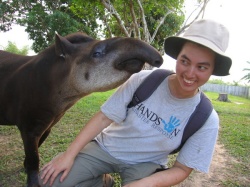
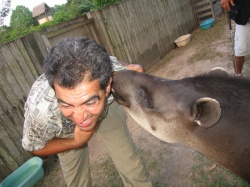
However, the friendliest animals were the pair of tapirs who loved licking salt of people's skin.
Back in Pucallpa, it was a busy Saturday night. The air was heavy with humidity and heat. After a cold shower, we went to the Plaza de Armas. It was packed and we heard drum and flute music. As we approached we saw groups of young people dressed in traditional Shipibo clothing. It was a competition and I was amazed by the energy the groups managed to muster up in the sweltering night. All of the dances were accompanied by live music. As one group finished, the main female dancer was escorted to the podium where she made a little speech and then introduced the next
group. It turned out to be the Senorita Pucallpa
beauty pageant. Each contestant was introduced through a traditional dance number backed up by a group from her village.
At the edge of the plaza, we got some pizza. While
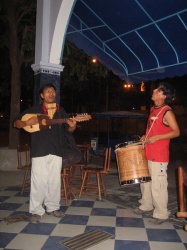
sitting at the restaurant, 3 musicians (a guitarist, a drummer in a punk rock t-shirt, and a charango/ panpipes player). They played the beautiful traditional Andean music I had fallen in love with when I first bought a cassette of Peruvian music, years and years ago. We'd been in Peru over a month and this was the first time we heard a group play this traditional music, acoustically. Now everywhere you hear panpipes playing effect laden renditions of pop songs. The electronic keyboard has done its share of chewing up traditional music, too. This group played and sang a few songs. Their voices blended in harmonies that make me think of mountains.
The next morning we woke to the crack of thunder and a down pour. This type of rain was a relief. It was as if the air, thick with heat and humidity finally cracked and all the irritation is released in cool rain.
Deeper into the Jungle
6 October, 2007, 05:40 pm in "Peru"
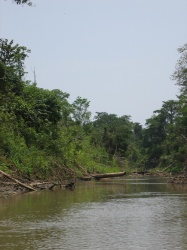 We weren't on the Ukayali very long: just a little upriver and across into a tributary. Making it up the tributary was difficult because the water was so low. Occasionally we hit mud or a submerged tree.
The tributary wasn't as busy as the canal but it still had a fair number of boats. It looks like there is a bit of logging going on. Hopefully it is sustainable. Individual workers take their dugouts to an area, hike out into the forest and then cut certain trees and then pile the lumber by the shore. We also saw several fish traps and nets and fishermen. Next to the river are occasional structures with thatched roofs or the more basic, 4 wooden poles with a tarp over them.
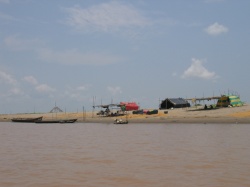
We see a lot of kingfishers, hawks and jacanas. One bird we saw while we were hiking in the jungle has the ability to imitate the calls of other birds. Some tribes believe feeding the brain of this bird to children will make them grow up to be smart. We also saw a couple very large green iguanas.
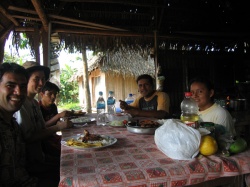
We had a lunch stop at a house by the river and our cook made fried chicken, plantains and rice over a fire covered with a grate.
Rowshan dug up some clay from the bank and sculpted some pieces.
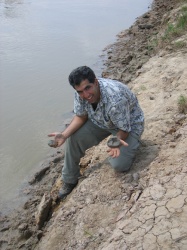
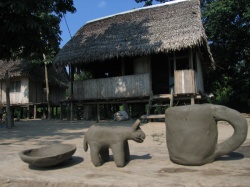
The people of the house were mostly relaxing. When we had arrived, they had been shelling a pile of dried beans by pounding the shells with a piece of wood then separating the red beans from the husks.
I was dismayed to see all the trash around the houses. I guess the attitude is when the river rises it will just sweep everything a way.
We got back into the boat and continued down the tributary. At a fork, Lalo asked an old man camped there which branch had more caymans. The man said the smaller one to the left.
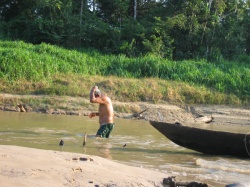
Eventually we reached the area we'd be camping. There was a cleared space and 4 wooden poles for a tarp. We had tents and mattresses. Rowshan made a pit kiln for his ceramics then we went on a short walk while water was being boiled for tea. We saw a beautiful blue butterfly flying about in the darkening forest. Then the sun set. Lalo said that since it is the dry season there are no mosquitoes. That must have been a relative term. As the sun set they began swarming. We had to rush to the tent and get our bug net hats. Even then we could hear them and the rest of our bodies were still targets.
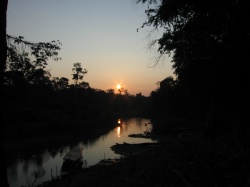
As it got darker, we went back to the boat with flashlights to search for caymans. We followed the tributary, shining our lights trying to catch the light in the caymans' eyes which would reflect red. We saw one but it disappeared before we got close. We followed the tributary until it became impassable then drifted back. On the way we spotted a group of red glowing eyes. The boat got close to one but it slipped under the water as we reached it. As we were discussing caymans, Lalo said the heads, along with the head of the anaconda were believed to bring money. This was because it was believed that cayman and anaconda can hypnotize their prey and attract them to where they can be caught. Rowshan said it was probably true the heads attracted money but only because people saw them, were curious and went into the store.
Back at the campsite, we jumped into our tents trying to escape the mosquitoes. The tent was full of them so we had to spend the next hour trying to kill them all. This was a challenge since we just had the light of a couple flash lights and mosquitoes don't smash very well against the sides of a tent. Swatting them with clothing and clapping them between our hands, we finally managed to get the tent mostly mosquito free (plugging the holes in the tent helped some). Even then, we could still hear the swarms outside the tent buzzing.
In the morning, the mosquitoes were still outside the tent but since we could see them we had a fighting chance. We took a morning walk looking for monkeys but didn't find any.
Back in the boat we headed back up the tributary and stopped at the house where we'd eaten the day before. While Tane cooked a very early lunch, Lalo took us for a walk to look for horned screamers.
On the way we crossed a field and ate berries from the Mujaka plant. The berries grow inside a flower which looks like a lantern. Lalo said the root is good for treating Dengue fever.
The lake was a marsh with no water in sight, though plenty of water plants revealing where the water was. The horned screamers are big black birds with white bellies and speckles on their necks. They make loud noises that sound like dogs or seals barking which can be heard from quite far.
We walked out to what had once been the lake edge and watched them fly into the trees. All around were lush green plants and swarms of butterflies and dragonflies. This is what is beautiful about the jungle, the abundance of life (though I could do without the mosquitoes).
Back at the house, Rowshan gave a little girl the clay dog he had made. She seemed unsure what to do with it. Rowshan pretended it barked and growled which scared the girl and made her cry. So he made it play football instead and patched things up.
Rowshan noticed a small wasp's nest which Lalo said belonged to poisonous shiro shiro wasps. Earlier, from the boat we had seen a huge bell wasp nest a couple feet long high up in tree. Lalo also pointed out the swelda plant which grows on other trees and is thought to be good for healing fractures if it grows on a lemon or orange tree which have strong wood.
As we got closer to the river, there was practically a traffic jam of boats moving slowly onward. Some perpetually had to be bailed and were loaded heavily with lumber. The end channel we were on had only been 3 meters a few years ago but the water from the Ukayali had opened it up to be 30 meters.
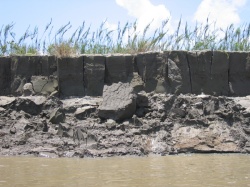
It must be so strange living in a place with such impermanence: canals coming and going, entire villages having to move, the river changing its path...
We crossed the river and found a group of dolphins. The dolphins are frightened of the boats. Fishermen illegally poach the dolphins because people pay a lot for the sexual organs because they believe they will help men be better at attracting women. Lalo said they had found several dead dolphins on the beaches with these parts taken out. The dolphin we found near Trujillo was most likely another victim of this belief since the only injury I'd noticed was a slit on its underside.
We cut the engine and watched the dolphins surfacing. Sometimes they'd swim under the boat leaving a trail of bubbles on the surface. We were headed back to the canal when there was a flash, a whack, and a splash. A fish had jumped out of the water and whacked Rowshan in the arm. There was a slimy fish shaped spot on his sleeve.
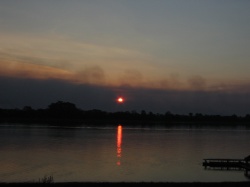
By the time we got back to the lodge we were quite ready to get off the boat. We spent the evening relaxing and finally saw the sunset over the lake.
Mr. Hanky, the toilet toad is still there.
Powered by My Blog 1.69. Copyright 2003-2006 FuzzyMonkey.net.
Created by the scripting wizards at FuzzyMonkey.net..
(Code modified by Rowshan Dowlatabadi)
Created by the scripting wizards at FuzzyMonkey.net..
(Code modified by Rowshan Dowlatabadi)