

Visiting San Francisco, Pucallpa
3 October, 2007, 11:43 am in "Peru"
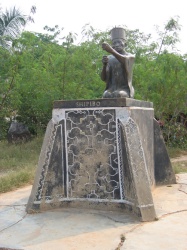 Even though we spent the night in Pucallpa, we didn't spend much time there. After a few errands, we hopped a shared taxi to Yarinacocha (Lake Yarina) and then another to the San Francisco Shipibo community where Luis, the guy we met on the bus lived.
The community is about 8 km from Puerto Callao, the main town on the lake. It is a small village with wood houses with thatched roofs. We tried calling Luis but our phone couldn't pick up any network. So, we asked at a store and were directed to a house a couple houses down. Luis was with his family and said he'd just been talking to them about us. He took us to an open area with a table, benches and a hammock.
He introduced us to his family and they gradually began bringing out arts and handicrafts.
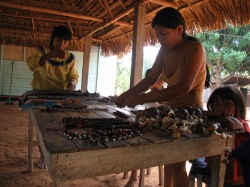
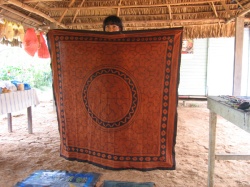
First his mother showed a beautiful brown cloth with a Shipibo design.
Then his sister brought out some paintings of Ayuhuasca visions she'd had. They were really interesting: lots of colors and patters. One had anacondas, another a lot of flowers. They were colorful and lush.
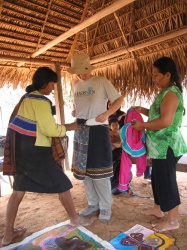
Then I had to run the gauntlet of jewelry. Eventually I bought a little piece of cloth with Shipibo designs on it. I really love the Shipibo designs. Now they are just interesting patterns but they seem to have originally represented something. At one of the museums in Lima, I read (bad translation by me) they represent "the roads of the sky and what is reflected from here below" which I thought was very poetic even if it may not be true. The patterns make me think of mazes or maps. I didn't bargain for the piece. I figured Luis's family could use the extra. I hate being sold to but Luis and his family were nice even if they perhaps just thought of us as easy customers. Luis showed walked with us down to the lake side.
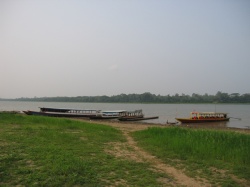
There was a long wooden path leading from the village to the water. During the rainy season when the waters rose, the village was right next to the lake. Luis took us to a neighbor's house where they made ceramics and Rowshan had fun looking at the clay and pigments.
Bus Ride through Armageddon
2 October, 2007, 07:22 pm in "Peru"
Having a week to kill before we could start art classes in Lurin, and being unable to get tickets to Iquitos on Sunday, we decided to take a bus to Pucallpa in the jungle east of Lima and the mountains, instead. Pucallpa is in the Amazon Basin but is actually on the Ucayali River which is one of the major rivers that becomes the Amazon.
We bought our bus tickets, paying double price for the "new" buses with reclinable seats, bathroom on board, air conditioning and lunch and dinner included. The bus ride is about 20 hours during the dry season. Later, at the hostel, Rowshan asked me, "Did you read the warning in Lonely Planet?"
"What warning?"
"The one about buses to Pucallpa." He handed me the book and at the top of the page, which I'd been looking at all day but somehow missed, was a warning in a box about the road to Pucallpa. Apparently there had been numerous robberies and although most occurred at night, the robbers were "becoming bolder" and had committed several in the early evening. Our bus was a night bus.
"Maybe it's outdated," Rowshan said hopefully.
"It was published this year." I said. I took some comfort that being the expensive bus (as opposed to a slower local bus), they wouldn't have any reason to stop and pick up potential robbers.
The bus was sort of new... at least in comparison to the cheap buses from that company. The seats were cushy and leaned back but didn't have lower leg rest things... a feature which I'm not sure I really like anyway. The bus was full and behind us sat a mother and crying child.
"Rowshan," I said. "This may be a bus ride from hell." The bus didn't leave too late. It headed east over small city streets and soon started climbing through the mountains, along side the railroad track to Huancayo which has the 2nd highest train station in the world. The child had stopped crying. Lunch was served followed by a movie.
The road for the first part wasn't too bad. I was a little surprised when the stewardess passed out plastic bags in case people got sick. Rowshan speculated that maybe people would get sick because of the altitude. The bus slowly moved along, making alarming grating noises whenever it changed gears. We began to wonder if we'd make it to Pucallpa. The road wasn't as scenic as the roads around Huaraz. There were a lot of mines and the villages were mining villages. There were some llamas and sheep grazing on the mountain sides, many with colorful tassel eartags. As we went over one pass, we were met with flurries of snow.
As it started to get dark, another movie was started. This time in English with Spanish subtitles (often they show movies dubbed into Spanish with Spanish subtitles). It was Armageddon. I've told several people about our Thai bus ride to the island of Koh Tau where they showed the movie, The Island about clones who were told they were going to this paradise called the Island when actually they were being killed and having their organs harvested.
Armageddon also turned out to be a suitable movie for the trip, not because of the story line but because of the way the bus managed to enhance the special effects.
For all who haven't seen it, Armageddon is
about an asteroid about to hit the Earth. Bruce Willis and a bunch of misfit oil drillers are sent to drill a hole in the asteroid, drop a nuke in and blow the thing up, saving all of humanity.
As the movie had been progressing, the road had been getting worse. There is a scene where the shuttles carrying the miners have to go through the space rubble around the asteroid in order to land on it. As the rocks smashed into the shuttles, the bus lurched violently. As the explosions occurred on the monitors, the sounds of rocks being kicked up and smashing against the wheel wells and sides of the bus became louder and more frequent. We expected one of the huge rocks from the cliffs above to smash through the bus as the rocks smashed through the shuttle on the screen. As the characters in the movie yelled, the baggage in the overhead compartments were thrown onto the passengers below who exclaimed as other passengers reflected the flurry of activity on the screen by jumping up to try to secure their bags or stow them safely on the floor. The shuttle in the movie crash landed on the asteroid. The bus bumped and swayed, throwing passengers left and right and making horrible mechanical grating noises.
"If we had this on a bigger screen it would be like Disneyland," I told Rowshan.
Unfortunately, during the brief lulls between explosions in the film, the bus did not cease to lurch. A couple times the smell of vomit wafted through the bus. A trip to the toilet was an adventure in itself. It had remained relatively clean (probably because no one really wanted to attempt to pee while being tossed around.) I had to throw my weight against the door to open it from the outside. From inside, I tried to pull it open. It didn't budge. Worried that pulling it with all my weight would throw me back into the large toilet behind when it did open, I had a brief image of being trapped in the bus toilet for the next 10 hours... everyone would just think I was sick. I finally managed to brace myself against the toilet seat and yank the door open, then stumble back to my seat without landing on anyone's lap.
The movie ended but the bus continued throwing us about. Occasionally a short paved section of the road would lead everyone to collectively sigh in relief only to be jarred again when we hit the more frequent badly/un-paved sections.
Rowshan and I began speculating about dinner. "Hope for sandwiches," I said. We decided they'd probably serve soup.
I had read that the road was bad but only from Tingo Maria to Pucallpa (the same stretch had the bandits). We weren't anywhere close to that town yet. We were still bumping down the mountain side.
We eventually got down the mountain and reached a town. The road was still bumpy but paved at least. The bus stopped at a restaurant where we were served huge dinners by nuns. It was around 10PM. Back on the bus, the road once again got bumpy and windy. The lights were turned off presumably so you could sleep. Suddenly a man entered and started giving what sounded like a sales talk. What usually happens is people board the bus, give their introductory talk, pass out candy and then collect money from you for it. I was surprised though that all of a sudden everyone was opening their wallets and giving him money. Then, in the darkness, I saw he had a gun. Fortunately, it wasn't in his hand. The next thing I noticed was everyone was only giving him 1 sol (about 33 cents).
Rowshan asked Luis, a man we'd been talking to until the bus made us too queasy to turn towards him, what was going on.
"Seguridad." Security.
We did not encounter any robbers on the ride. However, at a couple points the bus was boarded by a man with a gun who for a small donation of 1 sol each, would protect us from bandits over a section of the road. We paid.
Rowshan speculated that it was something similar to the guy who "for a small fee" will keep your car's
windshield from being smashed in. You pay the guy because if you don't, your windshield will most definitely be smashed in.
I'd like to believe it reflected a community effort to
make the roads safer. I did find it unnerving, though, that the bus driver was stopping to let men with guns board the bus. Rowshan said the driver probably knew their faces (In the dark on a street with no street lights.)
Whether we have our freelance security people to
thank, or if there aren't any robbers anymore because they've all become freelance bus security, our bus was not robbed.
However, the road did not get any better. All night we bumped, lurched, luggage fell, people shoved it back overhead and someone behind us puked.
I really wished I hadn't eaten that huge dinner. Unable to sleep I looked out the window trying to see the landscape change as we got to the jungle. The air was getting hotter (I could tell because the air conditioning turned off whenever the bus grinded and crunched into a low gear). Outside I saw fog and trees but we were still in the mountains. The houses seemed to utilize more wood. Perhaps we were in a cloud forest. By early morning we reached some paved yet bumpy roads. I'm guessing we must have hit some paved roads because I managed to doze off long enough to dream about passing a white rabbit around the bus... which I know really did not happen.
We weren't in deep jungle. It was tropical. There were lots of banana trees, hot humid air and wood houses with thatched roofs.
As we pulled into the station, the woman behind me held up my water bottle which had rolled back to her seat.
"Whose is this?" she asked.
"It's mine." I said, realizing as I took it that it was covered with dried puke. Rowshan placed it in our unused barf bags and we happily got off the bus.
We bought plane tickets back to Lima, first thing this morning.
We bought our bus tickets, paying double price for the "new" buses with reclinable seats, bathroom on board, air conditioning and lunch and dinner included. The bus ride is about 20 hours during the dry season. Later, at the hostel, Rowshan asked me, "Did you read the warning in Lonely Planet?"
"What warning?"
"The one about buses to Pucallpa." He handed me the book and at the top of the page, which I'd been looking at all day but somehow missed, was a warning in a box about the road to Pucallpa. Apparently there had been numerous robberies and although most occurred at night, the robbers were "becoming bolder" and had committed several in the early evening. Our bus was a night bus.
"Maybe it's outdated," Rowshan said hopefully.
"It was published this year." I said. I took some comfort that being the expensive bus (as opposed to a slower local bus), they wouldn't have any reason to stop and pick up potential robbers.
The bus was sort of new... at least in comparison to the cheap buses from that company. The seats were cushy and leaned back but didn't have lower leg rest things... a feature which I'm not sure I really like anyway. The bus was full and behind us sat a mother and crying child.
"Rowshan," I said. "This may be a bus ride from hell." The bus didn't leave too late. It headed east over small city streets and soon started climbing through the mountains, along side the railroad track to Huancayo which has the 2nd highest train station in the world. The child had stopped crying. Lunch was served followed by a movie.
The road for the first part wasn't too bad. I was a little surprised when the stewardess passed out plastic bags in case people got sick. Rowshan speculated that maybe people would get sick because of the altitude. The bus slowly moved along, making alarming grating noises whenever it changed gears. We began to wonder if we'd make it to Pucallpa. The road wasn't as scenic as the roads around Huaraz. There were a lot of mines and the villages were mining villages. There were some llamas and sheep grazing on the mountain sides, many with colorful tassel eartags. As we went over one pass, we were met with flurries of snow.
As it started to get dark, another movie was started. This time in English with Spanish subtitles (often they show movies dubbed into Spanish with Spanish subtitles). It was Armageddon. I've told several people about our Thai bus ride to the island of Koh Tau where they showed the movie, The Island about clones who were told they were going to this paradise called the Island when actually they were being killed and having their organs harvested.
Armageddon also turned out to be a suitable movie for the trip, not because of the story line but because of the way the bus managed to enhance the special effects.
For all who haven't seen it, Armageddon is
about an asteroid about to hit the Earth. Bruce Willis and a bunch of misfit oil drillers are sent to drill a hole in the asteroid, drop a nuke in and blow the thing up, saving all of humanity.
As the movie had been progressing, the road had been getting worse. There is a scene where the shuttles carrying the miners have to go through the space rubble around the asteroid in order to land on it. As the rocks smashed into the shuttles, the bus lurched violently. As the explosions occurred on the monitors, the sounds of rocks being kicked up and smashing against the wheel wells and sides of the bus became louder and more frequent. We expected one of the huge rocks from the cliffs above to smash through the bus as the rocks smashed through the shuttle on the screen. As the characters in the movie yelled, the baggage in the overhead compartments were thrown onto the passengers below who exclaimed as other passengers reflected the flurry of activity on the screen by jumping up to try to secure their bags or stow them safely on the floor. The shuttle in the movie crash landed on the asteroid. The bus bumped and swayed, throwing passengers left and right and making horrible mechanical grating noises.
"If we had this on a bigger screen it would be like Disneyland," I told Rowshan.
Unfortunately, during the brief lulls between explosions in the film, the bus did not cease to lurch. A couple times the smell of vomit wafted through the bus. A trip to the toilet was an adventure in itself. It had remained relatively clean (probably because no one really wanted to attempt to pee while being tossed around.) I had to throw my weight against the door to open it from the outside. From inside, I tried to pull it open. It didn't budge. Worried that pulling it with all my weight would throw me back into the large toilet behind when it did open, I had a brief image of being trapped in the bus toilet for the next 10 hours... everyone would just think I was sick. I finally managed to brace myself against the toilet seat and yank the door open, then stumble back to my seat without landing on anyone's lap.
The movie ended but the bus continued throwing us about. Occasionally a short paved section of the road would lead everyone to collectively sigh in relief only to be jarred again when we hit the more frequent badly/un-paved sections.
Rowshan and I began speculating about dinner. "Hope for sandwiches," I said. We decided they'd probably serve soup.
I had read that the road was bad but only from Tingo Maria to Pucallpa (the same stretch had the bandits). We weren't anywhere close to that town yet. We were still bumping down the mountain side.
We eventually got down the mountain and reached a town. The road was still bumpy but paved at least. The bus stopped at a restaurant where we were served huge dinners by nuns. It was around 10PM. Back on the bus, the road once again got bumpy and windy. The lights were turned off presumably so you could sleep. Suddenly a man entered and started giving what sounded like a sales talk. What usually happens is people board the bus, give their introductory talk, pass out candy and then collect money from you for it. I was surprised though that all of a sudden everyone was opening their wallets and giving him money. Then, in the darkness, I saw he had a gun. Fortunately, it wasn't in his hand. The next thing I noticed was everyone was only giving him 1 sol (about 33 cents).
Rowshan asked Luis, a man we'd been talking to until the bus made us too queasy to turn towards him, what was going on.
"Seguridad." Security.
We did not encounter any robbers on the ride. However, at a couple points the bus was boarded by a man with a gun who for a small donation of 1 sol each, would protect us from bandits over a section of the road. We paid.
Rowshan speculated that it was something similar to the guy who "for a small fee" will keep your car's
windshield from being smashed in. You pay the guy because if you don't, your windshield will most definitely be smashed in.
I'd like to believe it reflected a community effort to
make the roads safer. I did find it unnerving, though, that the bus driver was stopping to let men with guns board the bus. Rowshan said the driver probably knew their faces (In the dark on a street with no street lights.)
Whether we have our freelance security people to
thank, or if there aren't any robbers anymore because they've all become freelance bus security, our bus was not robbed.
However, the road did not get any better. All night we bumped, lurched, luggage fell, people shoved it back overhead and someone behind us puked.
I really wished I hadn't eaten that huge dinner. Unable to sleep I looked out the window trying to see the landscape change as we got to the jungle. The air was getting hotter (I could tell because the air conditioning turned off whenever the bus grinded and crunched into a low gear). Outside I saw fog and trees but we were still in the mountains. The houses seemed to utilize more wood. Perhaps we were in a cloud forest. By early morning we reached some paved yet bumpy roads. I'm guessing we must have hit some paved roads because I managed to doze off long enough to dream about passing a white rabbit around the bus... which I know really did not happen.
We weren't in deep jungle. It was tropical. There were lots of banana trees, hot humid air and wood houses with thatched roofs.
As we pulled into the station, the woman behind me held up my water bottle which had rolled back to her seat.
"Whose is this?" she asked.
"It's mine." I said, realizing as I took it that it was covered with dried puke. Rowshan placed it in our unused barf bags and we happily got off the bus.
We bought plane tickets back to Lima, first thing this morning.
[ View 1 Comments
|
]
Pachamanca in Lurin
29 September, 2007, 06:22 pm in "Peru"
 Plans change every instant. We arrived on an overnight bus from Piura, Tepsa, on someone's bad advice. Linea is a much better company but it unfortunately doesn't go direct from Piura to Lima.
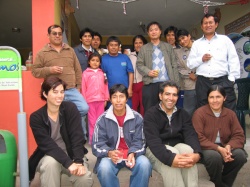
 We checked into a hostel, checked the internet, and then set off toward the center to catch the lunch folkloric show at Las Brisas de Titicacca. Minutes after we bought our tickets, Rowhsan called Dennis, the Peace Corps Volunteer in Lurin, who Chris, a PCV we met at the lodge in Huaraz had put us in touch with. (I'm getting the feeling I've been hanging out with more PCVs in Peru than I did when I was in the Peace Corps in Russia!) It turned out that the artists of Ichimay Wari were having a lunch event for several groups of touists featuring pachamanca, a traditional Peruvian dish of meat, chicken, potatoes, sweet potatoes, corn, tamales and beans, all cooked together in an earthen firepit with hot rocks.
We cancelled our reservations at Las Brises and hopped on a bus to Lurin. Dennis met us at the bus stop and led us to the Ichimay Wari space. There was a large concrete sports area that had a tent with people eating and dancers performing.
"It looks like they've started eating already. I hope there's food left!" Dennis said as we hurried into the building quickly being introduced to some of the artists on the way. There was still plenty of food and we ended up iwth large platefulls. The pachamanca was tasty. The meat was spicy and there was a hot pepper sauce that went with everything. Little cups containing Pisco sours were passed about. I had a sip. It was pretty good. The food was delicious.
After we finished we mingled a bit. Earlier we had been shown the gallery (while we were waiting for our plates to be prepared). There were lots of wonderful pieces: ceramics, retablos and woven tapestries.
One of the women there who spoke some English, led me outside to watch a dance and almost immediately we were pulled into it. After lunch was over we visited Maurelio's (one of the ceramic artists) studio. He answered Rowshan's questions (Dennis translated) and showed his clay and gazes as well as some of the different pieces. Most of the pieces being worked on were for an order so they were made from molds (which Maurelio had created from his original pieces). Dennis talked about how they are trying to work out a way to copyright the artist's designs since it is a big problem that artists like Maurelio would work hard to create an original piece and then other "artists" would rip off the designs. Apparently it has gotten so bad that some of the artists don't want to show new pieces they have worked for a long time on for fear of them being copied.
Rowshan will be studying ceramics with Maurelio in a week and we'll be staying with him and his family.
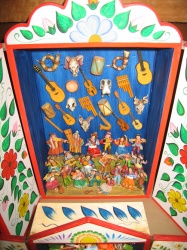
After that we went back to the Ichimay Wari space and had more Pisco sours and some desert. A pudding that reminded me of Turkish asura (Noah's Pudding). Then we headed over to Donato's studio. Donato makes retablos, wooden boxes containing scenes with figures made from flour paste.
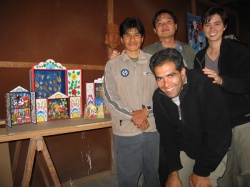
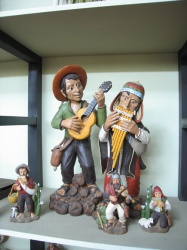
First he showed us a room where his wife was working painting. He showed us some of the paste and the molds (his originals) that he used. Dennis had mentioned that one of the terrible things about the earthquake was many of the artists had their molds broken. The main room wasfilled with pieces that were mostly mass produced for customers. However, in the next room Donato, had his fine art pieces. These were amazing detailed Retablos. One was of a fiesta with lots of musical instruments and people playing music.
One was a Peruvian annunciation scene with the angel and Mary in Peruvian attire. They were like looking at 3-D miniature paintings with careful color and detailed features. We felt really honored to see these pieces in the artist's studio.
Back at Ichimay Wari we were treated to more Pisco sours, joking and photos.
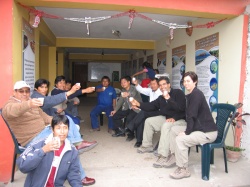
It was a fabulous afternoon and we learned the word for "drunk" in Quechua. The artists in Ichimay Wari mostly came to Lurin from Ayacucho during the 80s fleeing political problems and terrorism in the region. They are continuing the traditional arts of Ayacucho in Lurin. Tours of the artists' studios are available by contacting Ichimay Wari for anyone reading this who would like to see some of the finest examples of traditional Ayacuchan arts.
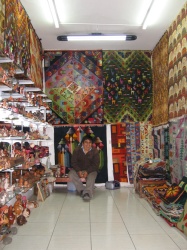
While we were wondering around Miraflores area, we stumbled on Emilio´s shop who does amazing woven tapestries.
Powered by My Blog 1.69. Copyright 2003-2006 FuzzyMonkey.net.
Created by the scripting wizards at FuzzyMonkey.net..
(Code modified by Rowshan Dowlatabadi)
Created by the scripting wizards at FuzzyMonkey.net..
(Code modified by Rowshan Dowlatabadi)