

Ceramics in Chulucanas
28 September, 2007, 08:22 pm in "Peru"
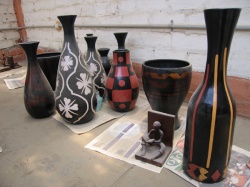 We had appointment with Mario (a representative of the La Encantada Cite Ceramics group) at 10:00. We woke up early and took the bus to Chulucanas. From there we went by motortaxi along a very tough road which we Mario later informed us, was actually a bit dangerous. Mario had the motortaxi return us to town using the main road.
 We were so lucky that Brent, a Peace Corps Volunteer for the town, arrived the same day and translated for us. We all walked through the workshop area and Mario explained the processes involved in making these unique ceramics which have officially been declared a part of Peru's cultural heritage.
After throwing the pots and triming them
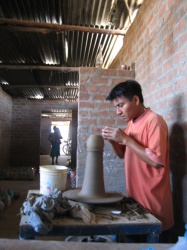 ,
, then glaze them while they are still wet. They apply the glaze on the wheel using a regular brush
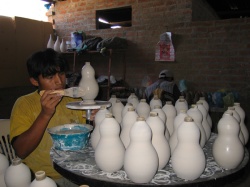 .
. They put 3 (red) to 6 (white) layers of glaze depending the color. After the glazing is done and the pots are dried, women of the village burnish the pots first using river stones and then plastic pieces made out of shampoo containers.
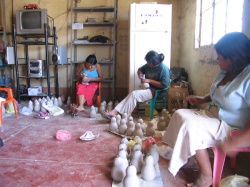
Next they fire the pots in wood-burning kilns at 800 degrees celsius for 7-8 hours and cool the pots for half a day. The next and most interesting part of the process is the smoking process. Parts of the pots are covered with a special slip made of soil, fine silt from river, agricultural soil and ash, to create designs.
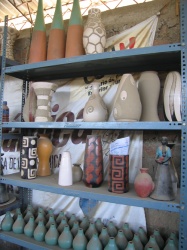
This layer of slip won't stick to the pots and protects the colors. They smoke the pots using mango leaves in another kiln for 1-4 hours depending on the size of the pots: shorter time for smaller pieces. Smoke makes the unique black color which is a key feature of the Vicus style. After the pots are smoked, the slip is washed and scraped off. To finish the process, they wax the pots to protect them and make them shinny. They also recommend that purchasers of the pottery wax them every few years.
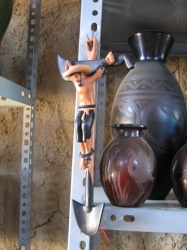
We also walked through some other workshops watching potters work. We went to one workshop who the famous Chulucanas potter, Max Inga had given the right to reproduce one of his most famous pieces.
Mario also took us to the clay harvesting field which was about half a mile away. There were two types of clays (black and yellow) that were mixed together to make the clay used for ceramics. They mix the clays in pools and also desalinize them. Then, they lay the wet clay on a plastic sheet to dry until it is ready for use.
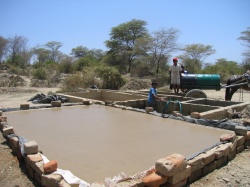
When I asked about the prcentage of each clay, Mario looked at me and told me something with a nice smile. Brent translated "It is their secret!!". The clay in the field was also used to make bricks. Brent said the owner had told him the price for bricks had gone up a lot after themost recent earthquake on August 15th 2007.
[ View 1 Comments
|
]
Piura
27 September, 2007, 06:22 pm in "Peru"
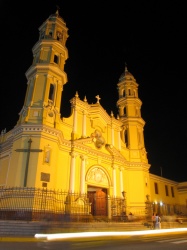 A traveler we met at one of the places we stayed said, "Piura is a trully dangerous place."
I responded, "Do you mean 'dangerous' as in you never want to leave... or really dangerous." "Really dangerous," was his reply. "All the restaurants have guys with guns hanging out outside."
Piura is nowhere near as exciting as all that. In fact, the scariest thing we saw there was not one but TWO purple Barney dinosaurs walking down the street armed with a bunch of multicolored yo-yos.
We didn't spend much time in Piura, however we did take a nice walk through the Plaza de Armes in the evening.
Chiclayo
26 September, 2007, 08:22 pm in "Peru"
 It is with a bit of difficulty that I'm keeping Chiclayo from blurring with Piura in my mind. The cities are similar and they were separated in my mind by sleepless bus rides. We were only in Chiclayo for one day (and night). Our main purpose was visiting the Lord of Sipan museum, which is considered to be Peru's best museum. It contains the contents the Peruvian equivalent to King Tut's tomb: a rare intact tomb that wasn't robbed so had vast amounts of gold as well as other precious items.
 According to LP, an archaeologist noticed a sudden influx of fine pieces on the black market. He traced them and found that they were coming from graves in Sipan. Further excavation uncovered a grave that hadn't been ransacked by the Spanish or discovered by later robbers.
The museum does a wonderful job in presenting the pieces. The lighting was especially well done casting huge shadows on the floor in the shape of items displayed. The museum was designed to imitate how the tomb was (a bit like the first Tutankhamen exhibit in the 70s. The darkness made the gold pieces set with turquoise even more enticing. There were also a lot of ceramics and other pieces that were found in the tomb.
Unfortunately, even though it is internationally famous, there were hardly any explanations in English which was unfortunate because there was a lot of information about the archaeological processes done during the excavation.
There was another archaeological museum in the area with more samples of gold and ceramics as well as some ethnographic displays: a potter's and weaver's workshop, shaman ceremony and fishers. It was interesting to see that the traditional walls in the dioramas were made the same way as some that we were pulling down in Pisco: bamboo-like reeds filled with adobe.
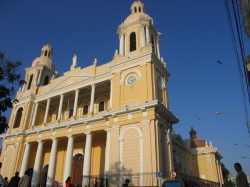
Another interesting thing that happened in Chiclayo was we saw blue sky. Rowshan was able to take a nice photo of the church on the Plaza de Armas with blue sky in the background. It was terribly exciting.
We also took a trip to the Mercado Modelo which is huge and takes up several blocks. On the outside of it is a seemingly impermeable layer of booths selling the typical market stuff: knock-off clothing, watches, trinkets, shoes. Eventually we found a way into the interior of the market. There was a lot of fruit, clothing, household items and food.
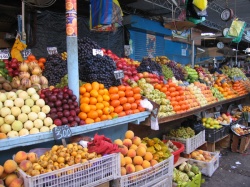
However, the most interesting part is the "witch doctor's market". This is the section where they sell all the herbal medicine as well as interesting items needed for working spells
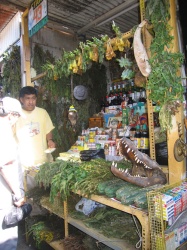 .
. There were lots of fragrant fresh herbs as well as interesting dried fruits or vegetables and other plant parts. There were lots of packages which had cures for digestive problems, sexual problems, arthritis and other ailments. There were also some things that looked like love potions, religious items, and some beauty products (snail beauty cream anyone?). We stopped at one booth which had a cayman head and a dried dead skunk. The man there tried to interest me in necklaces and then offered us San Pedro's cactus.
I laughed and he opened a plastic container containing a forest green powder. He gestured to us to smell it... as if we'd be able to confirm that it really was San Pedro's cactus by the smell. It smelled like dried plant matter.
We passed him up on it. Even though I admit I'm curious about what kind of hallucinations it causes and am fascinated by the historic use, I wasn't about to experiment with strange, powerful hallucinogens offered to me by strange men in markets in foreign countries.
It is with a bit of difficulty that I'm keeping Chiclayo from blurring with Piura in my mind. The cities are similar and they were separated in my mind by sleepless bus rides. We were only in Chiclayo for one day (and night). Our main purpose was visiting the Lord of Sipan museum, which is considered to be Peru's best museum. It contains the contents the Peruvian equivalent to King Tut's tomb: a rare intact tomb that wasn't robbed so had vast amounts of gold as well as other precious items.
According to LP, an archaeologist noticed a sudden influx of fine pieces on the black market. He traced them and found that they were coming from graves in Sipan. Further excavation uncovered a grave that hadn't been ransacked by the Spanish or discovered by later robbers.
The museum does a wonderful job in presenting the pieces. The lighting was especially well done casting huge shadows on the floor in the shape of items displayed. The museum was designed to imitate how the tomb was (a bit like the first Tutankhamen exhibit in the 70s. The darkness made the gold pieces set with turquoise even more enticing. There were also a lot of ceramics and other pieces that were found in the tomb.
Unfortunately, even though it is internationally famous, there were hardly any explanations in English which was unfortunate because there was a lot of information about the archaeological processes done during the excavation.
There was another archaeological museum in the area with more samples of gold and ceramics as well as some ethnographic displays: a potter's and weaver's workshop, shaman ceremony and fishers
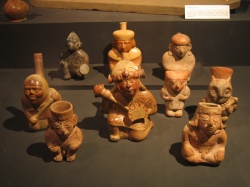 .
.It was interesting to see that the traditional walls in the dioramas were made the same way as some that we were pulling down in Pisco: bamboo-like reeds filled with adobe.
Another interesting thing that happened in Chiclayo was we saw blue sky. Rowshan was able to take a nice photo of the church on the Plaza de Armas with blue sky in the background. It was terribly exciting.
We also took a trip to the Mercado Modelo which is
huge and takes up several blocks. On the outside of it is a seemingly impermeable layer of booths selling the typical market stuff: knock-off clothing, watches, trinkets, shoes. Eventually we found a way into the interior of the market. There was a lot of fruit, clothing, household items and food. However, the most interesting part is the "witch doctor's market". This is the section where they sell all the herbal medicine as well as interesting items needed for working spells. There were lots of fragrant fresh herbs as well as interesting dried fruits or vegetables and other plant parts. There were lots of packages which had cures for digestive problems, sexual problems, arthritis and other ailments. There were also some things that looked like love potions, religious items, and some beauty products (snail beauty cream anyone?).
We stopped at one booth which had a cayman head and a dried dead skunk. The man there tried to interest me in necklaces and then offered us San Pedro's cactus.
I laughed and he opened a plastic container containing a forest green powder. He gestured to us to smell it... as if we'd be able to confirm that it really was San Pedro's cactus by the smell. It smelled like dried plant matter.
We passed him up on it. Even though I admit I'm curious about what kind of hallucinations it causes and am fascinated by the historic use, I wasn't about to experiment with strange, powerful hallucinogens offered to me by strange men in markets in foreign countries.
[ View 1 Comments
|
]
Powered by My Blog 1.69. Copyright 2003-2006 FuzzyMonkey.net.
Created by the scripting wizards at FuzzyMonkey.net..
(Code modified by Rowshan Dowlatabadi)
Created by the scripting wizards at FuzzyMonkey.net..
(Code modified by Rowshan Dowlatabadi)