

Ceramics in Tarica
21 September, 2007, 06:25 pm in "Peru"
 Huaraz is a small city, dwarved even further by the mountains that surround it. It had been almost completely destroyed by an earthquake in the '70s so most of the buildings are modern brick and concrete structures. Everywhere you look there are treking companies and the streets reveal a mix of foreign trekers, local indigenous Peruvians in traditional clothing and the more common contemporarily dressed urban Peruvians.
 Seeing some craftsmen painting some ceramic pieces near the Plaza des Armes, Rowshan attempted ato question them about their techniques. It turns out they were from Piura in the North. Their pieces were mostly stylized people made from brown clay and burnished smooth and shiny.
Another man stopped by while we were talking and recommended a village called Tarica, a place the owner of the hostel we were staying at had also mentioned.
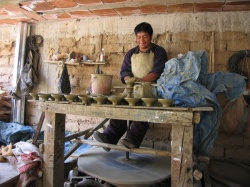
We boarded a combi and set off to the village. The trip was scenic with the road running along side a river and lots of trees and villages. We were let off at the village, an area of the road lined with artists' workshops. We walked into the first one. There were pots and pieces in rows on the floor and scattered on a few pieces of furniture. A boy came out and Rowshan told him he was a potter and asked to meet the potter. We were led into the back of the shop which had a fire burning and was part of their house. The rest of the area had a light roof but was open to the outdoors. There was a large fire powered kiln and a place for preparing the clay. A young man sat at a wooden wheel quickly making small clay bowls. His name was Pedro and he patiently fielded Rowshan's and my broken Spanish questions. His son had been working on putting handles on cups before we interupted.
Eventually Rowshan just took a video of Pedro explaining the process. Neither of us could understand what he was saying but since at somepoint we will learn Spanish, hopefully one day we will translate it.
I felt worried that we might be annoying them but both Pedro and his kids got a good laugh at our stilted communication attempts so at least we provided them some entertainment in return. As we were about to leave, Pedro's wife came in. We bought a simple clay cup from her and bid them 'adios' and walked up the street.
The ceramics made in Tarica are more utilitarian, functional pieces rather than fine art. The potters work quickly, churning out bunches of cups, pitchers, teapots, and dishes. The other pieces are basic tourist kitch: plaques made in molds imitating the designs at Chavin, little copies of the Chavin stone carvings or pieces with 'Huaraz' painted on them. The tourist pieces I couldn't care less about but the utilitarian pieces would have made a nice replacement for the mass poduced factory dishes everyone uses now.
The Andes Kick Our Butts
22 September, 2007, 10:47 am in "Peru"
 We just aborted a hike to Laguna Churup. I'm not sure if we are just really out of shape or if we can blame it all on altitude. We are staying at The Way Inn Lodge 15km from Huaraz up in the Cordillera Blanca. It was kind of a spontaneous decision. Wanting to figure out if we would suffer from altitude sickness, we didn't take our Diamox (we will however be taking it in Cusco). Due to this, we spent our first night with splitting headaches.
 We came up to the lodge yesterday. It was a bumpy but interesting ride. The taxi headed east out of Huaraz. Immediately the road headed upwards. Soon the pavement disappeared and the road became dirt and gravel. The road was lined with eucalyptus trees and the hills dropped down to streams and valleys. There were lots of adobe brick houses. Women in bright colored clothing, short flared skirts, and broad brimmed hats with a piece of colored cloth resting on the top, walked beside the road. The houses all had a few animals: donkeys, pigs, chickens and cows. There were small plots of land with corn and other crops. It seemed so peaceful. I wonder if the households were completely self sufficient.
Little dogs would run out into the road in front of the taxi. I was amazed our driver was able to avoid them. As we got higher, the mountains became more dominant. Even though it is the beginning of summer, there is still a lot of snow.
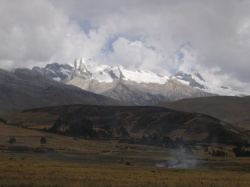
The lodge is at a high area at the base of some even higher peaks. You can see Huaraz way below. The mountain peaks are narrow and sharp and the area is breathtakingly beautiful. All around are farms and the locals bring their cows, sheep and donkeys out to graze. I'm not sure what the locals think of all the foreigners but they seem friendly enough once you smile and wave hola!
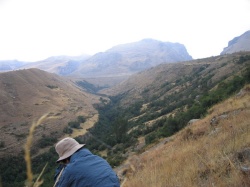
On our first afternoon we took a walk up the road. As we turned a corner Rowshan exclaimed, 'WOW!' The mountains dipped in a steep V and emerging from behind was a beautiful snow covered peak.
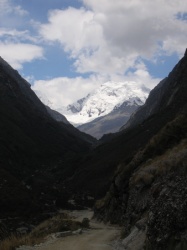
A small river swept down from the base of the mountain, through the valley and down to Huaraz
 .
. [ View 3 Comments
|
]
Huacas de Moche
19 September, 2007, 10:47 am in "Peru"
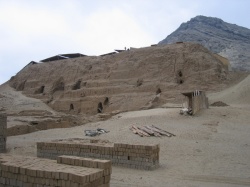 The Huacas de Moche are down a cobblestone street off of the Pan American Highway. The road leads through a quiet village. A stream/drainage ditch runs along side the road and the rushing water looks extremely picturesque. Our taxi brought us to the entrance of the Huaca de la Luna, driving past the larger Huaca de le Sol.
From the exterior, the Huaca de la Luna looks like a large pyramidic pile of bricks with roofs covering parts, pushed up against the side of an isolated peak which rises from the desert. Dusty sand has blown up against the sides creating dunes.
Our first stop in the temple was the courtyard where the mountain made up one side and the temple the other. There was an outcropping of rocks where losing warriors were doped up on San Pedro cactus and sacrificed.
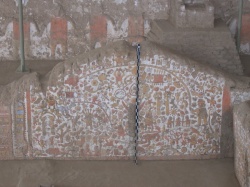
Inside the temple were walls of relief murals painted red, yellow, blue, white and black. The subjects were strange faces and stylized creatures: birds, snakes and stingrays
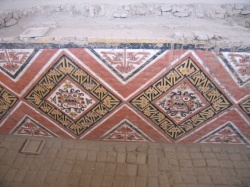 .
. The guide explained how after each high priest died, their temple was filled in with bricks and another was built on top. This preserved some of the lower layers. As archaeologists carefully uncovered each layer, all they did was preserve and conserve, not recreate. It was amazing how bright the colors had remained even after 2000 years.
The designs were fascinating-- very stylized. It must have been terrifying to be tripping on San Pedros cactus and be led into an area of strange fierce faces and designs and then be killed... although maybe for the priests it just looked really cool.
The murals of each temple changed slightly but all were strange and beautiful. It was an incredible contrast to the bleak desert.
From the top of the temple we were able to look across the ancient city of Moche
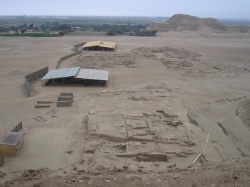 ,
, which is currently being excavated, to the Temple of the Sun. The last part had more murals including a wall of soldiers and dancers and a wall covered with many images including a scorpion, a child in an egg, a fisherman, rainbow, dogs and a multitude of other things. The guide said it may have been a calendar
 .
. After visiting the temple we walked by the ruins of the city to the base of the Temple of the Sun. It isn't being excavated at this time and I guess it isn't open. Instead we caught a very slow combi through the village. As it rolled along we were able to get a good view of the village. There were lots of restaurants but they didnt seem open. The conductor picked up a load of baskets and put them on the roof as the combi moved. One flew off into the stream next to the road so he had to chase after it and hook it with a reed he pulled from the bank. There were skinny cows, a couple pigs and fields of corn where white birds stood.
Once on the highway we picked up some speed.
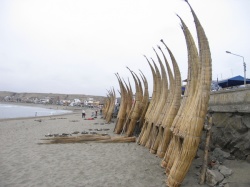
Having some time to kill before our night bus to Huaraz, we headed to Huanchaco, the beach resort town on the coast. Apparently it is off season. The beaches were mostly empty except for the iconic reed fishing boats, standing up on end in the sand
 .
. There were lots of restuarants and bars but they looked mostly closed. Walking up the beach we found a dead white dolphin
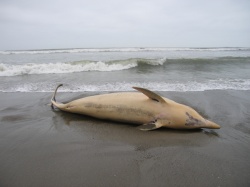 .
. From the distance I thought it was a buoy but as we got closer we could see its fins and tail so I hoped it was still alive and we could push it back into the sea and see it swim away. But it was dead. I had heard of pink dolphins in the Amazon (which are actually yellowish white) but this was salt water. I'm not sure if it was just an albino dolphin or some white dolphin species. One of the travelers we met said that in the Amazon the native people believe that the white dolphins were actually white men who became dolphins. This isn't really complimentary since apparently the pink river dolphins are considered one of the uglier species of the dolphin world.
Powered by My Blog 1.69. Copyright 2003-2006 FuzzyMonkey.net.
Created by the scripting wizards at FuzzyMonkey.net..
(Code modified by Rowshan Dowlatabadi)
Created by the scripting wizards at FuzzyMonkey.net..
(Code modified by Rowshan Dowlatabadi)